Where is Baalbek?
Baalbek lies in Lebanon’s Bekaa Valley. It sits east of the Litani River and about 67 kilometres northeast of Beirut. The temple complex stands at the foot of the southwestern slope of the Anti-Lebanon mountains, at roughly 1,150 metres above sea level.
In the Hellenistic period the city was called Heliopolis. In Greek that means ‘City of the Sun’. The ancient name is the key to the place: this was a sanctuary town, and the Romans built it on a very large scale.
What does the name Baalbek mean?
Nobody is sure. One explanation reads the name as ‘Lord of the Bekaa’, after the valley. Another theory derives it from Baal Nebeq, which would mean ‘Lord of the Spring’. Scholars still argue over both.
The Baalbek temple: a sanctuary for three gods
In Roman Heliopolis, worshippers honoured a triad of gods of Phoenician origin. The Romans knew them as Jupiter, Venus and Mercury. Each had a place in the complex.
The columns around the cella of the Temple of Jupiter rose about 20 metres.
The monumental Roman buildings at Baalbek were not a single project. Construction stretched over more than two centuries. An ICOMOS assessment from 1984 says work on the Temple of Jupiter began under Augustus on Hellenistic foundations. It was finished around AD 60, under Nero.
Other structures followed:
- The Temple of Bacchus dates to about AD 120–125.
- The great court dates to about AD 150.
- The Temple of Venus dates to the early 3rd century AD.
Baalbek ruins and the Trilithon
The name ‘Trilithon’ means ‘three stones’, and that is exactly what it is. Three giant blocks sit side by side, laid horizontally in the podium wall of the Temple of Jupiter.
Each block is about 19 metres long, 4.2 metres high and 3.6 metres thick. Each is calculated at roughly 750–800 tons.
Here is an everyday way to feel that scale. You know how hard it is to slide a heavy wardrobe across a room. Now picture a single block as long as a large passenger bus. Then picture three of them, lifted into a wall above the ground.
Baalbek megaliths: the stones that never left the quarry
The Trilithon is not the whole story. The quarry holds heavier blocks, and this is the real answer to the 1,000-ton question.
The BTU Cottbus-Senftenberg research page describes two groups. Blocks that were actually moved and set in the temple weigh up to 800 tons. Limestone blocks left in the quarry weigh more than 1,000 tons.
Three quarry stones are known:
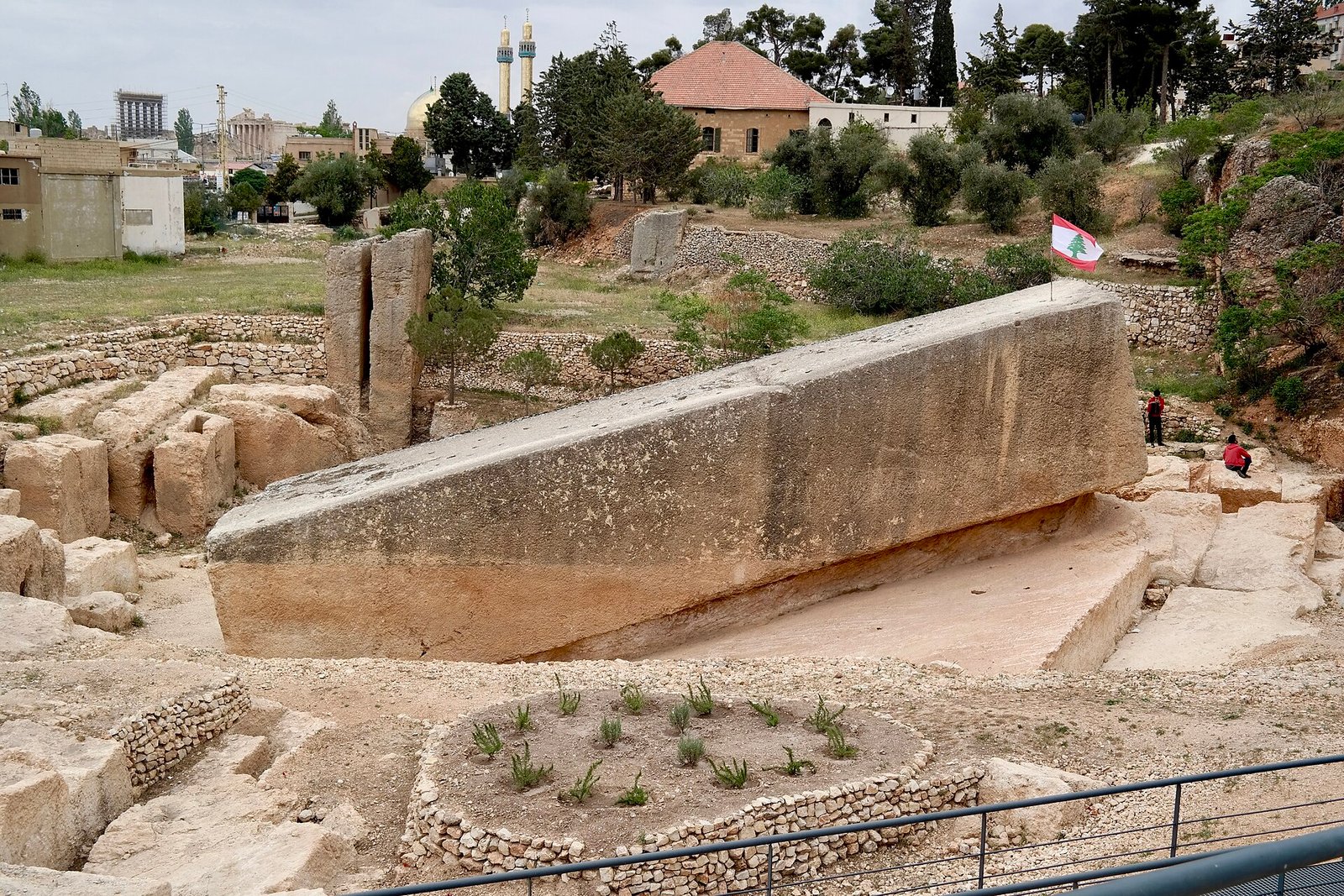
- Hajjar al-Hibla means ‘Stone of the Pregnant Woman’. Its weight is calculated at about 1,000 tons. It lies in the ancient quarry about 900 metres from the Heliopolis temple complex.
- A second monolith, uncovered again in the 1990s in the same quarry, is calculated at about 1,242 tons.
- A third block, found in summer 2014, is calculated at about 1,650 tons.
So ‘Romans moved 1,000-ton blocks’ needs care. The stones that sit in the temple wall weigh about 750–800 tons. The 1,000-ton and heavier blocks stayed where they were cut.
The 2014 discovery
In summer 2014, Lebanese and German researchers worked in the quarry. Next to Hajjar al-Hibla, and in a lower rock layer, they uncovered another block of about 1,650 tons.
It measures 19.60 metres long and 6 metres wide. It is at least 5.5 metres high.
Jeanine Abdul Massih of the Lebanese University directed the fieldwork. The Lebanese Directorate General of Antiquities cooperated on the project. The German Archaeological Institute announced the results in 2014.
How did the Romans move 1,000-ton blocks?
The honest answer is that nobody can say for sure. Researchers have proposed engineering models, but the exact method used is still a hypothesis in the scientific literature.
One theory says the Trilithon blocks were pulled out of the quarry over temporary earth fills, on rollers. Think of moving a fridge on a few round pipes. The load rolls forward, and the pipes are picked up from behind and set down in front.
A second model comes from Jean-Pierre Adam, who published his study in the journal Syria in 1977. He proposed rollers, vertical-axis capstans for pulling, and pulley blocks. This is a mechanical model. It is not direct proof that the same arrangement was used at Baalbek.
A third line of work is modern. From 2015, a research project at BTU Cottbus-Senftenberg looked into practical options for the horizontal transport and vertical placement of the Baalbek megaliths. Klaus Rheidt led the project, and Volker Wetzk worked on it.
The lifting job is as hard as the pulling job. These blocks had to be set into the podium wall, not just dragged along the ground.
Details you won’t find in guidebooks
- The big stone is still attached. The lower part of Hajjar al-Hibla remains connected to the bedrock. The block was never fully freed.
- It was abandoned for a reason. According to the German Archaeological Institute’s 2014 statement, Hajjar al-Hibla was left behind because of poor-quality stone in one corner. It also had a natural crack that could have made it break in transport.
- The 1,650-ton block was meant to be delivered whole. Its short face has been dressed, and preparations for dressing its long face are visible. The excavation team took this as evidence that the stone was planned to leave the quarry at these huge dimensions.
- The route did not climb. The quarry sits slightly higher than the temple complex. The giant blocks therefore did not need to be raised uphill along the way.
- Only a staircase is left of one temple. Of the Temple of Mercury on Cheikh Abdallah Hill, only a staircase cut into the rock survives.
Timeline
- Hellenistic period: the city is known as Heliopolis.
- Augustus period (27 BC–AD 14): according to ICOMOS, building of the Temple of Jupiter begins.
- About AD 60: according to ICOMOS, the Temple of Jupiter is finished under Nero.
- About AD 120–125: ICOMOS dates the Temple of Bacchus to these years.
- About AD 150: ICOMOS dates the great court to this time.
- Early 3rd century AD: according to ICOMOS, the Temple of Venus is built.
- 1977: Jean-Pierre Adam’s study on moving and placing megaliths appears in Syria.
- 1984: Baalbek is added to the UNESCO World Heritage List.
- 1990s: the second quarry monolith, of about 1,242 tons, is uncovered again.
- Summer 2014: the Lebanese-German team uncovers the block of about 1,650 tons.
- 2015: BTU’s research project on ancient megalith transport begins.
Visiting Baalbek: what to know
UNESCO inscribed the Baalbek archaeological site in 1984 under cultural criteria i and iv. If you go, plan your visit around three things:
- The Trilithon in the podium wall of the Temple of Jupiter. Stand next to it and look up at the 19-metre length.
- The quarry, about 900 metres from the temple complex. This is where you can see Hajjar al-Hibla.
- The Temples of Bacchus and Venus, which show how the site kept growing over the centuries.
FAQ
Where is Baalbek?
Baalbek is in the Bekaa Valley in Lebanon, east of the Litani River and about 67 kilometres northeast of Beirut. The temple complex stands at roughly 1,150 metres above sea level.
How heavy are the Baalbek stones?
The three Trilithon blocks in the temple’s podium wall are calculated at about 750–800 tons each. Blocks left in the quarry are heavier: about 1,000, 1,242 and 1,650 tons.
What does the name Baalbek mean?
The origin is disputed. One explanation reads it as ‘Lord of the Bekaa’. Another derives it from Baal Nebeq, ‘Lord of the Spring’. Its Hellenistic name, Heliopolis, means ‘City of the Sun’ in Greek.
Is Baalbek a World Heritage Site?
Yes. UNESCO listed the Baalbek archaeological site in 1984 under cultural criteria i and iv.
Sources
- UNESCO World Heritage Centre — Baalbek whc.unesco.org
- ICOMOS — Baalbek World Heritage evaluation (1984) whc.unesco.org
- Wikipedia — Baalbek Stones en.wikipedia.org
- Wikipedia — Baalbek en.wikipedia.org
- Turkish Wikipedia — Baalbek tr.wikipedia.org
- BTU Cottbus-Senftenberg — Antike Transporttechniken b-tu.de
- German Archaeological Institute — excavation announcement, 2014 idw-online.de
- Jean-Pierre Adam — Syria 54, 1977 persee.fr
Image: Stone of the Pregnant Woman in Baalbek, Beirut.jpg — Choinowski, CC BY-SA 4.0