The Birth of Venus painting: what are you looking at?
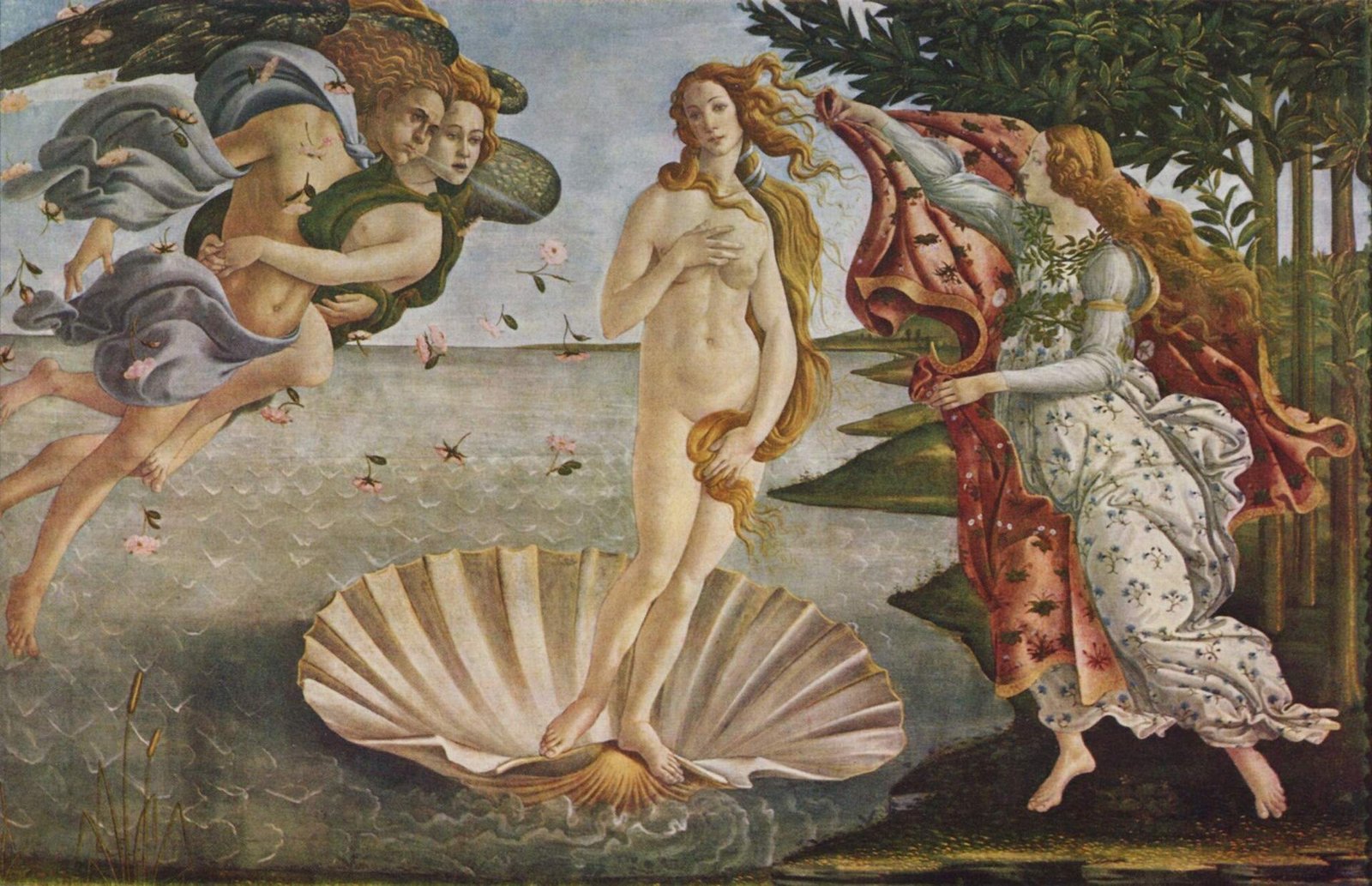
Sandro Botticelli’s The Birth of Venus shows a goddess reaching the shore on a giant scallop shell. The Uffizi dates the painting to around 1485. Its familiar title needs a small adjustment in your imagination: the scene shows Venus arriving after her birth from sea foam, rather than the moment of birth itself.
Venus stands naked at the center. On the left, the wind god Zephyros blows her toward land. On the right, a woman extends a flower-covered cloth to receive her. If you follow those figures from left to right, you can read the action as wind, arrival, and welcome.
The painting is tempera on canvas. It measures 172.5 centimeters high and 278.5 centimeters wide, according to the Uffizi. Those dimensions matter when you picture the original. The shell, the flying pair, and the waiting woman occupy a canvas much wider than it is tall.
The Birth of Venus by Sandro Botticelli: the story behind the scene
The myth behind the painting begins with violence. Kronos castrates Uranus and throws his sexual organs into the sea. Venus subsequently emerges from the sea. Botticelli’s subject belongs to the later part of that story: the goddess has already been born and is approaching the coast.
The Uffizi identifies her destination as Cyprus. That gives the scene a particular setting within the myth. Venus is traveling toward a shore where a waiting figure offers a covering. The shell beneath her carries the central figure through this arrival scene.
Zephyros supplies the movement. His breath drives Venus toward the land, while a woman flies in his embrace. One identification calls her Aura. Another calls her Chloris, a flower nymph. These are alternative interpretations of the companion’s identity, so neither should be treated as an unquestioned name tag.
The receiving woman also has more than one proposed identity. One interpretation identifies her as the Hora of Spring. The Uffizi also allows the possibility that she is one of the Three Graces. Her floral covering and the windborne roses help connect the scene with spring.
The Birth of Venus meaning: love, beauty, and spring
The Uffizi interprets Botticelli’s Venus as a symbol of love and beauty. This gives you a clear starting point for reading the picture. The central goddess carries that meaning, while the roses and the figure associated with spring add a seasonal dimension to her arrival.
A Neoplatonic interpretation takes the meaning further. In this reading, Venus’s physical beauty can lead the viewer toward divine love. The visible body becomes the starting point for a spiritual response. This is an interpretation of the painting.
Other interpretations connect the work with marriage. They consider Venus and the surrounding action in relation to the behavior of a bride and groom. The marriage reading and the Neoplatonic reading therefore ask different questions about the same goddess: how beauty guides love, and how love relates to married life.
The roses provide a more direct symbol. The Uffizi explains them as a reminder of spring. Think of the flowers you might choose for an everyday greeting: they can communicate alongside a gesture. Here, the roses accompany Venus’s arrival and reinforce the seasonal association of the waiting woman.
Venus’s body also deserves careful attention. Her elongated neck and anatomically problematic left shoulder show that Botticelli did not follow strict realism. You can notice those features while considering the painting’s emphasis on beauty. The figure’s proportions do not offer a straightforward anatomical model.
Who commissioned Botticelli’s The Birth of Venus?
A prominent theory connects the commission with the Medici family. Herbert Horne gave that argument a specific form in 1908, linking the painting to Lorenzo di Pierfrancesco de’ Medici. This attribution belongs to the painting’s interpretation and ownership debate; it is not a settled identification of the patron.
Ronald Lightbown argued that the work entered Medici ownership later. His reasoning drew on its absence from the 1499 inventory. The disagreement matters because later possession and an original commission are separate claims. Evidence for one does not automatically establish the other.
The poet Agnolo Poliziano also appears in a proposed account of the painting’s origins. According to this theory, he may have suggested the subject to Botticelli. The Uffizi presents that connection as a possibility. Poliziano’s proposed involvement should therefore remain distinct from the established attribution to Botticelli.
The painting’s presence at the Medici villa at Castello has firmer documentation. Giorgio Vasari described it there in 1550. The Italian Ministry of Culture records its first appearance in the Castello inventory in 1598. These dates document its later setting without settling who originally ordered it.
Timeline
- Around 1485: Botticelli painted The Birth of Venus, according to the Uffizi’s dating.
- 1499: The painting did not appear in the inventory cited in Lightbown’s argument.
- 1550: Giorgio Vasari described the work at the Medici villa at Castello.
- 1598: The painting was first entered in the Castello inventory.
- 1815: The Birth of Venus and Botticelli’s Primavera moved from Castello to the Uffizi.
- 1908: Herbert Horne linked the commission to Lorenzo di Pierfrancesco de’ Medici.
Details you won’t find in guidebooks
The highlights in Venus’s blond hair include real gold. The light in her hair therefore involves an actual application of gold, giving you a specific feature to examine beyond the shell and the goddess’s pose.
The canvas support consists of two pieces sewn together before painting began. That construction belongs to the physical object beneath the scene. Botticelli’s tempera image rests on a joined support, a practical detail that is easy to overlook when your attention stays on the mythological figures.
The flying wind couple has a proposed connection with an ancient object. The Uffizi links their model to a Hellenistic engraved gem owned by Lorenzo the Magnificent. This connects the embracing figures with a particular object associated with him. It does not, by itself, identify the painting’s commissioner.
Scientific examination revealed that the woman identified as the Hora originally had low classical sandals. This earlier design adds another layer to the figure who waits with the floral covering. Her appearance developed during the making of the painting, rather than remaining fixed from its first conception.
Some colors have also changed. Green pigment in Zephyros’s wings and the orange leaves darkened through exposure to light. That alteration changed the painting’s color balance. The greens you see today therefore carry part of the material history of the work, alongside its mythological story.
The Birth of Venus location: where is it located?
Botticelli’s The Birth of Venus is displayed in the Uffizi Gallery in Florence, Italy. If you are arranging travel around this painting, Florence is the destination attached to the original. Its present home follows the documented transfer from Castello to the Uffizi in 1815.
Primavera moved from Castello with it. The shared transfer places the two Botticelli paintings together at a specific moment in their ownership history. The Italian Ministry of Culture also records The Birth of Venus as state property, under number 878 in the 1890 inventory.
FAQ
Who painted The Birth of Venus, and when?
Sandro Botticelli painted The Birth of Venus. The Uffizi dates it to around 1485.
What does The Birth of Venus mean?
The Uffizi presents Venus as a symbol of love and beauty. Neoplatonic interpretations connect her physical beauty with divine love, while other readings relate the painting to marriage.
Where is Botticelli’s The Birth of Venus located?
The painting is displayed in the Uffizi Gallery in Florence, Italy. It moved there from Castello in 1815.
Who are the other figures beside Venus?
Zephyros blows Venus toward the shore from the left. His companion is identified as Aura or Chloris, while the woman holding a floral covering is usually identified as the Hora of Spring, with one of the Three Graces offered as another possibility.
Sources
- Uffizi Galleries — Birth of Venus uffizi.it
- Italian Ministry of Culture — Catalogo generale dei Beni Culturali catalogo.beniculturali.it
- Turkish Wikipedia — Venüs’ün Doğuşu (Botticelli) tr.wikipedia.org
- English Wikipedia — The Birth of Venus en.wikipedia.org
Image: Sandro Botticelli 046.jpg — Sandro Botticelli, Public domain