Who was Suleiman ibn Qutalmish?
Suleiman ibn Qutalmish was the founder and first ruler of the Sultanate of Rum. Also known as Suleiman Shah I, he captured Nicaea, today’s İznik, and made it his capital. His career connected that city with Byzantine struggles for the throne and campaigns toward Antioch and Aleppo.
If you are exploring İznik through its history, Suleiman provides a starting point for its role as a Seljuk capital. Yet his story cannot be reduced to a single foundation date. Historians differ over when his state began and how its authority should be understood.
His career also extended well beyond Nicaea. Around 1075, he operated from Birecik in southeastern Anatolia. He later captured Antioch and fought near Aleppo. He died on 4 June 1086 after a defeat by the forces of Tutush.
Who was Suleiman ibn Qutalmish’s father?
Suleiman’s father was Qutalmish, also written as Kutalmış. His grandfather was Arslan Yabgu. His great-grandfather was Seljuk Bey. The name Suleiman ibn Qutalmish identifies him through his father, while the Turkish form Kutalmışoğlu Süleyman Şah expresses the same family connection.
His brothers also appear in accounts of the state’s beginnings. Mehmet Altay Köymen lists their known names as Mansur, Alp İlek or Alp Yülük, and Devlet or Dolat. The alternative forms belong to the names as transmitted in the historical discussion.
Family relationships mattered in Suleiman’s early campaigns. According to Mehmet Şeker, he besieged Aleppo in July 1075 after his brothers became prisoners of Atsız. This connects an early attack on Aleppo with the fate of his brothers.
Suleiman himself had sons named Kılıcarslan and Davud. After his death, Malikshah took Kılıç Arslan to Isfahan. His family story therefore continues beyond the battle that ended his own rule.
Sultan Suleiman ibn Qutalmish and the foundation at Nicaea
Suleiman captured Nicaea and established his capital there. This is the central fact behind his identification as the founder of the Sultanate of Rum. The disagreement concerns the date and interpretation of that foundation, rather than Nicaea’s place in his rule.
Şeker describes competing dates for the city’s capture. Some historians accept 1075, the date given by Azimi. Others argue for a date between 1078 and 1081. You should therefore treat a precise foundation year as an interpretation that needs attribution.
Köymen offers another way to understand the beginnings. He distinguishes the brothers’ shared authority in 1073 from Suleiman’s sole rule in 1077. Under this interpretation, the emergence of the state and the establishment of one ruler belong to different stages.
An everyday comparison helps explain this distinction. Sharing responsibility for a household and later taking sole responsibility are different milestones. Köymen’s separation of shared rule in 1073 and sole rule in 1077 likewise gives the foundation story more than one possible starting point.
The state’s relationship with Malikshah is also debated. One account describes an independent state from 1077. Another interpretation presents Suleiman as subordinate to Malikshah. Calling him the founder does not, by itself, settle the degree of independence he exercised.
How did Suleiman intervene in Byzantine politics?
In 1078, Suleiman received a request for help from Michael VII. He then supported the rival claimant Nikephoros Botaneiates, who offered more favorable terms. His participation in the contest therefore involved a change of allegiance between competing candidates for the Byzantine throne.
After Suleiman supported Botaneiates, Turkmens received permission to settle on the Anatolian shore of the Bosphorus. This gives the alliance a consequence beyond the throne struggle itself. The agreement affected where those settlers could establish themselves.
Suleiman supported another Byzantine claimant, Nikephoros Melissenos, in 1080. His involvement in Byzantine politics was therefore repeated. The support for Botaneiates in 1078 and Melissenos in 1080 belongs alongside his territorial campaigns when assessing his career.
These alliances also help you place Nicaea within his wider activities. Suleiman’s capital was part of a political story that included the Byzantine throne and settlement on the Bosphorus. His later departure for an eastern campaign added another direction to that story.
From Nicaea to Antioch and Aleppo
Around 1075, Suleiman used Birecik as a base for conquests in southeastern Anatolia, according to Köymen. His activities in that region preceded the eastern expedition of 1084. Aleppo had already been a target during the crisis involving his brothers in July 1075.
When Suleiman set out east in 1084, he left the administration of Nicaea to Abu’l-Qasim. This detail identifies who held responsibility for the capital during his absence. The eastern campaign did not require Suleiman to administer Nicaea in person.
Antioch fell in two stages. Suleiman took the city on 12 December 1084. Its citadel remained outside his control until 12 January 1085. These dates distinguish possession of the city from possession of its fortified stronghold.
On 20 June 1085, Suleiman defeated Muslim ibn Quraysh, the emir of Mosul. Muslim died during the fighting. Suleiman then besieged Aleppo in July 1085 and placed the city under siege again in 1086.
The sequence matters when you follow his final campaigns. The capture of Antioch came before the defeat of Muslim ibn Quraysh. The renewed pressure on Aleppo followed. Suleiman’s death occurred near Aleppo after these successive military operations.
Details you won’t find in guidebooks
Suleiman’s first siege of Antioch ended through negotiation. He lifted it after reaching an agreement with the governor, Isaac Komnenos, for 20,000 dinars. This earlier settlement belongs separately from the capture of the city in December 1084.
After taking Antioch, Suleiman ordered his troops to treat the Christian population well. He also instructed them not to enter people’s homes. The order concerned the conduct of soldiers toward residents after the conquest.
He also permitted two churches at the request of Antioch’s Christians. They were dedicated to Mary and Saint George. The permission provides a specific example of his decisions concerning Christian religious life after the city’s capture.
Another detail concerns the evidence for his authority. No record is identified of Suleiman issuing coins in his own name or having the khutba delivered in his name. This absence forms part of the discussion about his political status. It does not establish a foundation date or settle the independence debate by itself.
Timeline
- 1073: Köymen places the beginning of the brothers’ shared authority in this year.
- Around 1075: Suleiman operates from Birecik. In July 1075, he besieges Aleppo after his brothers become prisoners of Atsız.
- 1075 or 1078–1081: Competing interpretations date Nicaea’s capture, and thus the state’s foundation, to 1075 or to a year between 1078 and 1081.
- 1077: Köymen dates the beginning of Suleiman’s sole rule to this year.
- 1078: Suleiman supports Nikephoros Botaneiates in the Byzantine throne struggle.
- 1080: He supports Nikephoros Melissenos.
- 1084: He leaves Nicaea under Abu’l-Qasim’s administration and departs on an eastern campaign.
- 12 December 1084: Antioch’s city falls to Suleiman.
- 12 January 1085: Antioch’s citadel falls.
- 20 June 1085: Suleiman defeats Muslim ibn Quraysh, who dies in the fighting.
- July 1085 and 1086: Suleiman besieges Aleppo, then renews the siege.
- 4 June 1086: He dies following defeat by Tutush’s forces at Aynusaylam, near Aleppo.
How did Suleiman Shah I ibn Qutalmish die?
Suleiman’s final defeat took place at Aynusaylam, near Aleppo, on 4 June 1086. His opponent was Tutush. The date and setting provide a clear endpoint to his career, but accounts differ over the precise circumstances of his death.
One tradition says Suleiman killed himself after the defeat. Another says he died on the battlefield. A further version of the battlefield account describes an arrow striking his face. These are competing reports, so no single manner of death should be presented as certain.
According to the TDV İslâm Ansiklopedisi, Tutush had Suleiman’s body buried at the Aleppo Gate. The same account regards the attribution of the Turkish tomb at Ca’ber to Suleiman ibn Qutalmish as unsupported by sources. The two burial claims should therefore remain distinct.
FAQ
Who was Suleiman ibn Qutalmish?
Suleiman ibn Qutalmish, also called Suleiman Shah I, was the founder and first ruler of the Sultanate of Rum. He captured Nicaea and made it his capital.
Who was Suleiman ibn Qutalmish’s father?
His father was Qutalmish. His grandfather was Arslan Yabgu, and his great-grandfather was Seljuk Bey.
When did Suleiman establish his state at Nicaea?
The date is disputed. Different interpretations place the capture of Nicaea and the state’s foundation in 1075 or between 1078 and 1081. Köymen identifies 1077 as the beginning of Suleiman’s sole rule.
How did Suleiman ibn Qutalmish die?
He died on 4 June 1086 following defeat by Tutush’s forces at Aynusaylam, near Aleppo. Accounts differ between suicide after defeat and death in battle.
Sources
- TDV İslâm Ansiklopedisi — “SÜLEYMAN ŞAH I” islamansiklopedisi.org.tr
- Mehmet Altay Köymen, Belleten — “Süleyman Şah ve Anadolu Selçuklu Devleti’nin Kuruluşu” belleten.gov.tr
- Mehmet Şeker, Selçuklu Medeniyeti Araştırmaları Dergisi — “Süleyman-Şah I” dergipark.org.tr
- English Wikipedia — “Suleiman ibn Qutalmish” en.wikipedia.org
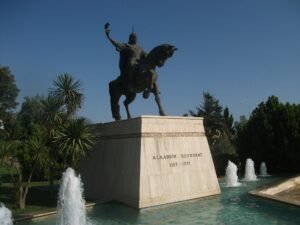
Image: MonumentOfKutalmişoğluSüleymanŞahTarsus.JPG — CeeGee, CC BY-SA 4.0