Siddhartha Gautama lived in the 6th or 5th century BCE. He was a wandering religious teacher in the eastern Ganges Plain, and he founded Buddhism. This article follows his traditional life story from Lumbini in Nepal to Bodh Gaya in India. It also shows where that story rests on inscriptions and excavations, and where it rests only on later tradition.
Gautama Buddha Was Born In Lumbini: The Birthplace
Lumbini is accepted as the birthplace of the Buddha. Today it lies in the Terai Plain in southern Nepal. UNESCO lists it as “Lumbini, the Birthplace of the Lord Buddha”, and the site entered the World Heritage List in 1997.
So if you ask where Gautama Buddha was from, the answer is Nepal by modern borders. He did not grow up at Lumbini, though. In the traditional account he was raised at Kapilavastu, about 30 miles away.
Two names help you read the sources. “Buddha” is a title meaning “awakened one”. It is used for Siddhartha Gautama in connection with his enlightenment. “Shakyamuni” means “sage of the Shakya clan”. It points to the community he belonged to.
Gautama Buddha Birth Date and Year: Why There Is No Single Answer
You will see different birth years in different books. This is not sloppy editing. The experts really disagree.
- UNESCO gives his birth as 623 BCE.
- Modern research also uses about 563 BCE and about 480 BCE.
- The Theravada tradition dates his death to 543 BCE. K. R. Norman places it between 410 and 390 BCE instead.
The safe summary is this. He lived in the 6th or 5th century BCE, and no exact year is agreed.
Think of a family story told at the dinner table for generations. Everyone agrees on the plot, but nobody remembers the exact year it happened. Early Buddhist history works much the same way.
Gautama Buddha Story: The Traditional Biography
The following is the traditional account, not a verified record. Buddhist biographical tradition names his father as Shuddhodana and his mother as Maya. His wife is Yashodhara and his son is Rahula.
The Four Encounters
Buddhist legend describes four meetings that changed him. Siddhartha sees an old man, a sick man, a dead man and a wandering religious seeker. Through them he faces the suffering built into human life.
Leaving Home at 29
According to the traditional biography, he left his palace at night at the age of 29. He began the life of a wandering ascetic. Early Buddhist sources name two teachers from whom he learned meditation: Alara Kalama and Uddaka Ramaputta.
Six Years of Austerity
The traditional life story says he practiced severe austerity for six years. He came close to death from hunger. Then he accepted rice offered by a young girl. He concluded that wearing down the body does not bring liberation.
Enlightenment at Bodh Gaya
Buddhist tradition says he meditated under a pipal tree at Bodh Gaya and reached enlightenment at the age of 35. Bodh Gaya is in the Indian state of Bihar today. From then on he is called the Buddha.
The biography describes the path he proposed as the Middle Way. It is a way of practice that avoids extremes.
The First Sermon and Death
The tradition says he gave his first sermon in the Deer Park at Sarnath, near Benares. He then spread his teaching for 45 years. He died at Kushinagar at the age of 80.
What the Buddha Taught
The teaching is framed by the Four Noble Truths. They deal with four things:
- Suffering.
- The source of suffering.
- The end of suffering.
- The path that leads to its end.
One word is often misread. The concept of taṇhā does not mean every wish. It means insatiable craving, the kind tied to suffering and to rebirth. So wanting a cup of tea is not the target. Craving that never feels satisfied is.
Gautama Buddha Photo and Real Photo: Does One Exist?
No real photograph of the Buddha exists. He lived in the 1st millennium BCE. The widely circulated pictures are artworks made later.
Early Buddhist art did not show him as a person at all. Artists used symbols instead:
- an empty throne
- footprints
- the Dharma wheel
- the Bodhi tree
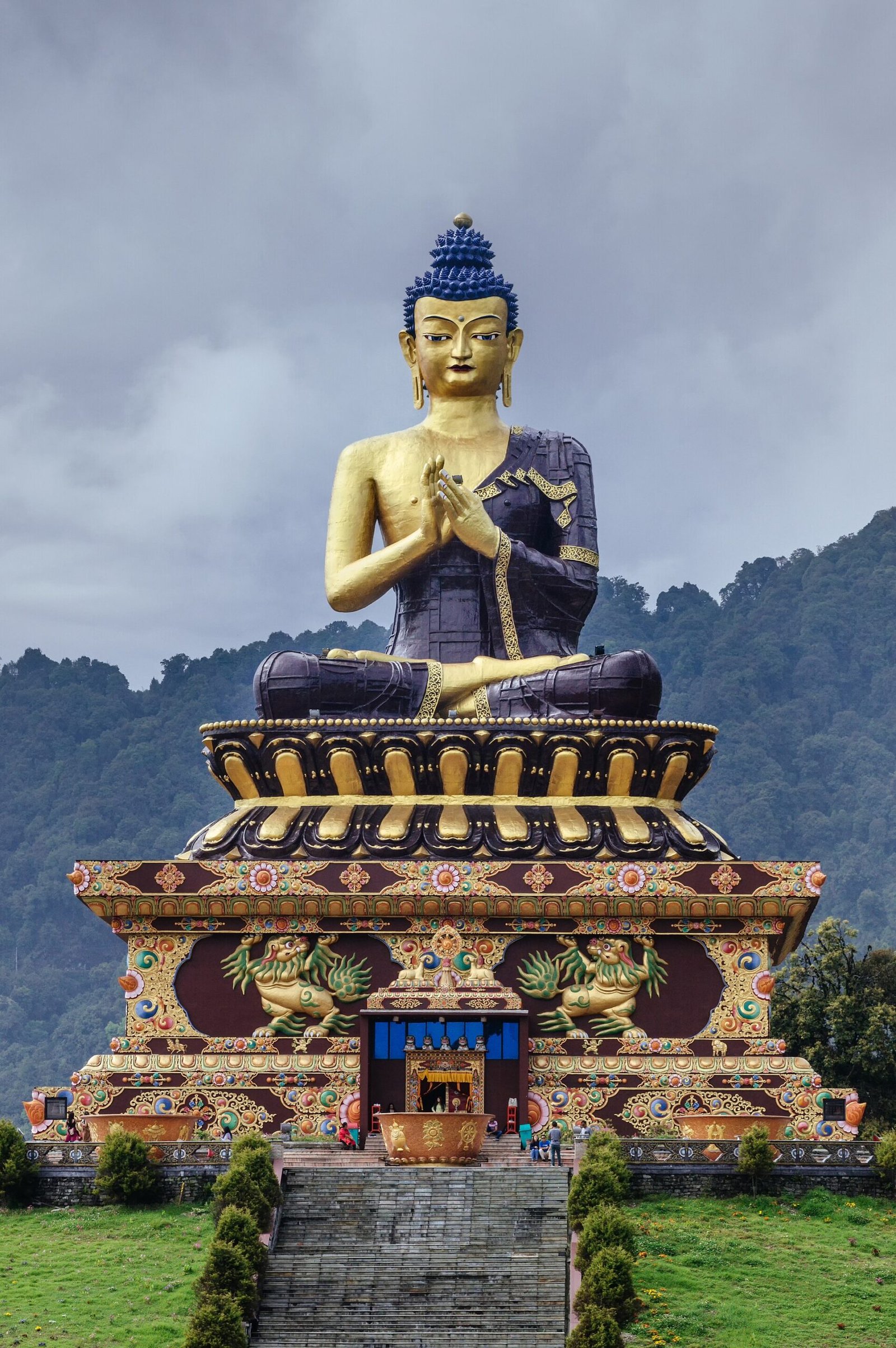
So a search for “gautama buddha images” or “gautama buddha drawing” leads to later art. Statues, paintings and sketches show how each era and place imagined him. They are not portraits taken from life.
Timeline
- 1300 BCE: The village remains near the Maya Devi Temple at Lumbini date from this period.
- 623 BCE / about 563 BCE / about 480 BCE: The competing dates for the Buddha’s birth. There is no agreement on the exact year.
- Age 29 (traditional account): Siddhartha leaves home and begins his ascetic search.
- Next six years (traditional account): He practices meditation and severe austerity, then gives up the methods that wear down the body.
- Age 35 (traditional account): He reaches enlightenment at Bodh Gaya and is called the Buddha.
- After enlightenment (traditional account): He gives his first sermon in the Deer Park at Sarnath.
- Age 80 (traditional account): He dies at Kushinagar. Proposed death dates include 543 BCE in the Theravada tradition and 410–390 BCE in K. R. Norman’s view.
- 249 BCE: Ashoka has a pillar with an inscription set up at Lumbini marking the Buddha’s birthplace.
- 1st century BCE: Much of the Pali collection may have been written down for the first time in Sri Lanka.
- 1st century CE: Ashvaghosha’s Buddhacarita, a life of the Buddha, is dated to this period.
- 1997: Lumbini is added to the UNESCO World Heritage List.
Details You Won’t Find in Guidebooks
A pillar that names the place. Ashoka had a pillar set up at Lumbini in 249 BCE. Its Brahmi inscription identifies the spot as the Buddha’s birthplace. This is a written record made in stone, and it is far older than the biographies.
A wooden structure under the brick. Beneath the brick layers of the Maya Devi Temple, archaeologists found traces of a wooden structure. It had an open space at its center and dates to the 6th century BCE.
Experts read it differently. Robin Coningham interprets the early structure as a Buddhist shrine. Julia Shaw says it could be an older tree shrine with no link to the Buddha. Both views are on record.
Settlement older than the legend. Village remains a few hundred meters south of the Maya Devi Temple push settlement around Lumbini back to 1300 BCE.
Two temples at Bodh Gaya. The Mahabodhi Temple standing today dates to the 5th or 6th century CE. The first temple on the site was built by Ashoka in the 3rd century BCE.
The four encounters on silk. In Mogao Cave 17 at Dunhuang, a silk banner of the 8th or 9th century CE was found. It shows Siddhartha’s meeting with old age and sickness.
The Sources: How We Know the Story
The earliest full-length biographies came centuries after his lifetime. The Buddhacarita is an epic written by Ashvaghosha in the 1st century CE. The Pali collection of teachings attributed to the Buddha may have been written down in Sri Lanka in the 1st century BCE.
That is why historians treat the biography with care. The religious narrative is one source. Inscriptions and excavations are another. They sometimes agree, as at Lumbini, and they sometimes leave questions open.
Was He a Prophet? A Note from Medieval Writers
Ibn al-Nadim’s Fihrist records different opinions about the Buddha. Some writers considered him an angel, some a demon and some a prophet. The work does not offer one shared reading.
Visiting Lumbini
Lumbini is the practical starting point. It sits in the Terai Plain in southern Nepal. Stand near Ashoka’s pillar and you stand where an inscription from 249 BCE names the place as the birthplace. Bodh Gaya, the site of the enlightenment in Bihar, is in India, so the two main sites lie in different countries.
FAQ
Where was Gautama Buddha born?
Lumbini is accepted as his birthplace. It lies in the Terai Plain in southern Nepal. UNESCO lists it as the birthplace of the Lord Buddha, and it joined the World Heritage List in 1997.
When was Gautama Buddha born?
Nobody can give one agreed year. UNESCO gives 623 BCE. Modern research also uses about 563 BCE and about 480 BCE. Sources place him in the 6th or 5th century BCE.
Is there a real photograph of the Buddha?
No. He lived in the 1st millennium BCE, long before photography. Every familiar image of him is an artwork made later.
What does the word Buddha mean?
It means ‘awakened one’. It is a title used for Siddhartha Gautama in connection with his enlightenment. Shakyamuni, another name for him, means ‘sage of the Shakya clan’.
How old was the Buddha when he reached enlightenment and when he died?
In the traditional biography he was 35 when he reached enlightenment at Bodh Gaya. He then taught for 45 years and died at Kushinagar at 80.
Sources
- English Wikipedia, Gautama Buddha en.wikipedia.org
- Smithsonian National Museum of Asian Art, Encountering the Buddha asia.si.edu
- Metropolitan Museum of Art, Life of the Buddha metmuseum.org
- UNESCO, Lumbini, the Birthplace of the Lord Buddha whc.unesco.org
- Turkish Wikipedia, Gotama Buda tr.wikipedia.org
- Internet Encyclopedia of Philosophy, Buddha iep.utm.edu
- Lumbini Museum, Lumbini, Where I was Born lumbinimuseum.org
- British Library / International Dunhuang Programme, The Origins of Buddhism idp.bl.uk
- UNESCO, Earliest Buddhist shrine in South Asia discovered in Lumbini unesco.org
- Science News, Early shrine unearthed at Nepal Buddhist site sciencenews.org
- UNESCO, Mahabodhi Temple Complex at Bodh Gaya whc.unesco.org
Image: Large Gautama Buddha statue in Buddha Park of Ravangla, Sikkim.jpg — Subhrajyoti07, CC BY-SA 4.0