Mevlana Museum in Konya: what are you visiting?
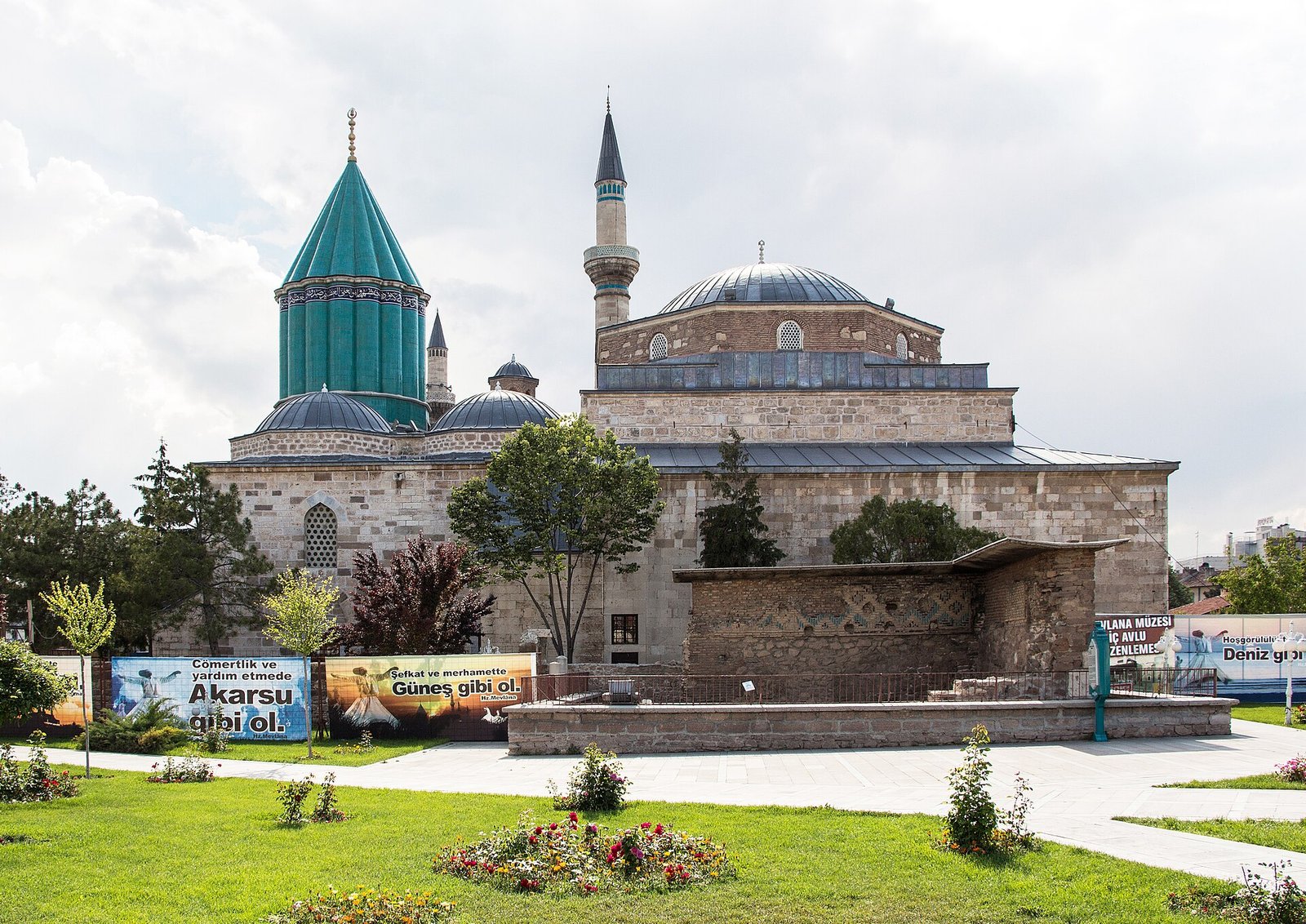
Mevlana Museum occupies the historic Mevlana lodge in Konya’s central Karatay district. The complex contains Mevlana’s tomb and buildings associated with Mevlevi life. Its turquoise-tiled Green Dome is the most recognizable feature. Around it, dervish rooms, a kitchen, a semahane, and a mosque reveal how the lodge expanded over time.
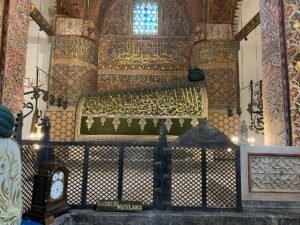
When you visit, the tomb is only part of the story. The museum also preserves manuscripts, a wooden sarcophagus, tomb textiles, and objects associated with the lodge. Together, these connect the burial place to teaching, food preparation, books, and the daily organization of the complex.
Mevlana Museum history: how did a rose garden become a lodge?
The site began as a rose garden belonging to the Seljuk palace. Sultan Alâeddin Keykubad gave it to Mevlana’s father, Bahâeddin Veled.
Mevlana died on 17 December 1273 and was buried beside his father. A tomb was built over his grave in 1274. Known as Kubbe-i Hadrâ, it was constructed by Tebrizli Bedrettin on four massive supports. The burial site became the architectural center around which the later complex developed.
The building you see contains work from different periods. Museum researcher Naci Bakırcı dates the tomb’s ribbed conical roof and the domes covering the graves to 1396, during the Karamanoğulları period. Ottoman additions included the semahane, mosque, dervish rooms, and kitchen. Its history therefore extends well beyond the original tomb.
What should you see beneath and around the Green Dome?
Start with the exterior of the Green Dome. Its outer covering carries turquoise tiles, the feature behind its familiar name. Keep the dates separate as you look: the tomb was built in 1274, while Bakırcı dates the ribbed roof and the domes over the graves to 1396.
Then consider the arrangement of the courtyard. Dervish cells line its northern and western sides. The kitchen and Hürrem Paşa Tomb stand to the south. This layout helps you connect individual buildings to their place within the lodge, rather than treating each doorway as an isolated stop.
The covered courtyard fountain adds another dated element. The Culture Portal attributes it to Yavuz Sultan Selim in 1512. The western dervish rooms followed in 1584, during the reign of III. Murad. With its rose gardens, the museum grounds cover approximately 18,000 square meters.
Mevlana Museum and whirling dervishes: what is the connection?
The connection lies in the Mevlevi lodge itself. Its Ottoman additions included a semahane, alongside the mosque, kitchen, and dervish accommodation. These buildings place the sema tradition within a larger setting of residence, learning, and religious practice.
The kitchen, or matbah, is especially revealing. It served for food preparation, but also for dervish training and learning sema. Think of the everyday connection between cooking and learning: here, a room associated with meals also had an educational role. That makes the kitchen an important stop when you explore the lodge’s working spaces.
The Mevlevi Sema ceremony received UNESCO recognition as a masterpiece in 2005. It entered the Representative List of the Intangible Cultural Heritage of Humanity in 2008. These dates concern the ceremony represented by the museum’s Mevlevi heritage.
Which manuscripts should you know about?
One important manuscript is the Mesnevî copy with inventory number 51. Mehmed bin Abdullah el-Konevî wrote it in November 1278. Its precise date gives you a firm point of comparison with the tomb, which had been constructed in 1274.
The manuscript contains 312 folios. Its pages follow a layout of four columns and 29 lines. These details make it possible to think about the book as a physical object: a long text organized through a repeated arrangement of writing across the page.
The collection also includes a Dîvân-ı Kebîr manuscript dated 1366. The complex’s Specialist Library was founded in 1854 by Postnişin Mehmed Saîd Hemdem Çelebi. The manuscripts and the library’s founding date add a history of books to the history of the tomb and lodge.
Details you won’t find in guidebooks
Mevlana’s wooden sarcophagus dates to 1274 and was made from kiln-dried walnut. The material gives a concrete detail to remember alongside the turquoise tiles outside. The sarcophagus and the tomb share a date, but one directs attention to woodworking and the other to architecture.
A tomb covering commissioned by II. Abdülhamid in 1895 was replaced in 2021 because it had deteriorated. The older covering was then placed under protection. The textile therefore carries two dates worth remembering: its original commission and the later action taken to preserve it.
The Nisan Tası takes its name from a custom involving April rain. Rainwater collected in the vessel was distributed to visitors with the intention of healing. Its name preserves the link between a museum object, a particular season, and a practice associated with visitors to the lodge.
The dervish rooms also contain a less obvious museum history. During repairs in 1929, internal dividing walls were removed to create three halls. Archaeological objects were initially displayed there. Those changes show how accommodation within the lodge was adapted for a different purpose after its conversion into a museum.
Timeline
- 17 December 1273: Mevlana died; he was subsequently buried beside his father.
- 1274: The tomb over Mevlana’s grave was built.
- 1278: The Mesnevî manuscript numbered 51 was written.
- 1396: Bakırcı dates the ribbed roof and domes over the graves to this year.
- 1584: Dervish rooms were built during III. Murad’s reign.
- 1854: The Specialist Library was founded.
- 1895: The tomb covering commissioned by II. Abdülhamid was made.
- 1926: Conversion of the lodge into a museum was decided.
- 2 March 1927: The English museum account dates the public opening to this day.
- 1929: Dividing walls in some dervish cells were removed to create exhibition halls.
- 1954: A new display arrangement introduced the Mevlana Museum name.
- 2021: The 1895 tomb covering was replaced and preserved.
How did the lodge become a museum of local history?
The museum’s opening is described differently by two accounts. The Culture Portal gives 1926 as the opening year. The English museum account distinguishes the conversion decision on 6 April 1926 from the public opening on 2 March 1927. Keeping that distinction makes the transition easier to follow.
The name Mevlana Museum came into use with a new display arrangement in 1954, during Mehmet Önder’s directorship. For readers interested in local history, the complex brings together several parts of Konya’s past: a Seljuk palace garden, a burial place, later lodge buildings, and rooms adapted for museum displays.
Mevlana Museum photos and reviews: what should you look for?
For exterior photographs, useful subjects include the turquoise-tiled dome, the covered courtyard fountain, and the arrangement of the dervish rooms. Each has a historical connection you can identify: the tomb’s development, the fountain attributed to 1512, and rooms built in 1584.
When reading museum reviews, use the complex’s contents to shape your own priorities. The tomb, manuscripts, kitchen, and altered dervish cells offer different points of interest. A visit centered on books will draw attention to the 1278 Mesnevî; one centered on architecture will follow the courtyard and successive building phases.
FAQ
Where is Mevlana Museum in Konya?
The museum occupies the historic Mevlana lodge in central Karatay. Its official address is Aziziye Mahallesi, Müze Alanı Caddesi No:1.
What is the Mevlana Museum entrance fee?
The Ministry of Culture and Tourism’s fee list gives free admission for both Turkish identity card holders and foreign visitors.
What are Mevlana Museum’s opening hours?
The official museum page, as read on 25 October 2026, lists visiting hours of 09:00–17:00 and ticket-office closing at 16:30. The museum opens every day; on Mondays, the ticket office opens at 10:00.
How is Mevlana Museum connected to whirling dervishes?
The historic lodge includes a semahane, dervish rooms, and a kitchen used for training and learning sema. UNESCO proclaimed the Mevlevi Sema ceremony a masterpiece in 2005 and inscribed it on its Representative List in 2008.
Sources
- Culture Portal — Mevlâna Müzesi kulturportali.gov.tr
- Türkiye Museums — Mevlana Müzesi muze.gov.tr
- Ministry of Culture and Tourism, DÖSİMM — Museum and Archaeological Site Fees dosim.ktb.gov.tr
- Naci Bakırcı — Mevlâna Müzesi, Arış aris.gov.tr
- İstanbul University — Mesnevî Manuscript Catalogue Study nek.istanbul.edu.tr
- UNESCO — Mevlevi Sema Ceremony ich.unesco.org
- Wikipedia — Mevlâna Museum en.wikipedia.org
- Vikipedi — Mevlânâ Müzesi tr.wikipedia.org
Image: Mevlana Müzesi 01.jpg — Bernard Gagnon, CC BY-SA 3.0