Hassan-i Sabbah is one of the most misquoted figures of the medieval Middle East. Popular culture turns him into a drug-dealing mastermind. The documented record shows a different man: a scholar, an organizer and a political strategist who took a mountain fortress in Iran and built a state around it. This guide separates what historians can support from what later storytellers added.
Where Was Hassan-i Sabbah From?
Hassan-i Sabbah was born around 1050 in the Iranian city of Qom. His family followed Twelver Shia Islam. They settled in Rey, and that is where he received his first religious education.
Rey changed his life. Ismaili missionaries were active there, and their influence led him to adopt Ismailism at about the age of 17. He did not stay a student of local teachers for long. Ismaili learning pointed toward Egypt, then ruled by the Fatimid caliphs in Cairo.
Hassan-i Sabbah and Islam: Which Branch Did He Follow?
He was a Shia Muslim all his life. He began in the Twelver tradition of his family and moved to the Ismaili branch as a teenager.
He reached Egypt in 1078 and continued his Ismaili education there for about three years. On the way home he passed through Aleppo and Baghdad. In 1081 he was back in Isfahan.
He also wrote. His treatise, known as the Four Chapters, set out the doctrine of ta’lim: religious knowledge depends on the teaching authority of the imam of the age. The full Persian text is lost. Pieces of it survive in the accounts of Shahrastani and other historians.
How Did Hassan-i Sabbah Take Alamut Castle?
Alamut stands in the Alborz (Elburz) Mountains, in Iran’s Qazvin Province, near the village of Gazor Khan.
Hassan took it in 1090. He did not fight a pitched battle. His supporters settled in the region and in the castle itself, and the fortress came into his hands. Think of it as a takeover by quiet relocation, not a siege.
Historians treat 1090 as the start of a political movement against Seljuk rule. That movement grew into the Nizari Ismaili state.
Why Did Hassan-i Sabbah Break With Cairo?
The Fatimid caliph al-Mustansir died in 1094. Two sons had competing claims to the succession. The Cairo establishment recognized al-Musta’li. Hassan supported Nizar instead and left the Cairo center.
This split created the Nizari Ismailis. Notice what Hassan did not claim. He never said he was the imam. In the Nizari community he was known as the hujja, the chief representative of the hidden imam.
Who Were the Assassins?
The fighters in Hassan’s assassination policy were called fida’is. They targeted leading figures among political enemies who were stronger in numbers and military power. Targeted killings were aimed at the most prominent opponents, not at matching them in open warfare.
The Seljuk response was military. In 1109 Sultan Muhammad Tapar began a long campaign against Alamut. It did not capture the castle.
The Drug Legend: What Historians Say
The famous story says Hassan drugged young men and showed them a false paradise, so that they would die gladly on his orders. Farhad Daftary explains this tale as the product of hostile accounts and of legends that developed in Crusader circles.
The word itself feeds the myth. English “assassin” comes from a name the Crusaders used for the Nizaris, connected to forms of the word hashish. But a word’s origin does not prove a practice. The etymology does not confirm the claim of training by drugs.
A second story says Hassan, the poet Omar Khayyam and the vizier Nizam al-Mulk were schoolmates in Nishapur. Encyclopaedia Iranica rejects it as historical fact.
Who Was the Old Man of the Mountain?
Crusader writers used the title “Old Man of the Mountain”. It did not first belong to Hassan. It was first applied to Rashid al-Din Sinan, who led the Syrian Nizaris after Hassan and died in 1193.
Timeline
- About 1050: Hassan-i Sabbah is born in Qom.
- 1078: He reaches Egypt to continue his Ismaili education.
- 1081: He returns to Isfahan.
- 1090: He takes Alamut and makes it his political base.
- 1094: In the Fatimid succession split, he supports Nizar.
- 1109: Muhammad Tapar begins a long campaign against Alamut.
- 1124: Hassan dies at Alamut after an illness. The day is given as 23 May or 12 June.
- 1256: Alamut is surrendered to the Mongols and destroyed.
- 2026: Alamut and six related fortifications join the UNESCO World Heritage List.
Details You Won’t Find in Guidebooks
A farming valley. Hassan improved the agriculture and irrigation of the Alamut Valley. The aim was a fortress that could feed itself.
Water engineering. The Ismaili castles around Alamut had cisterns, channels and underground water-conveyance systems. They allowed these castles to survive long sieges. If you have ever relied on a rooftop water tank during a summer cut, you know the logic. The fortress stored its own supply.
Books and instruments. After the Mongol conquest in 1256, the historian Juvayni recorded that he saw scientific books, astrolabes and armillary spheres at Alamut. That does not match the image of a den of killers. It describes a place of study.
A lost biography. Sargudhasht-i Sayyidna is a lost Persian biography of Hassan, and its first part may have been autobiographical. Two manuscripts in London carry that title. They are not the original. They are late compilations copied in India in the early twentieth century.
A destroyed shrine. Hassan’s tomb near Alamut was a pilgrimage site for the Nizaris. The Mongols destroyed it in 1256.
How Did Hassan-i Sabbah Die?
No dagger ended his life. Encyclopaedia Iranica says he died at Alamut in 1124 after a short illness.
The exact day is disputed. Turkish Wikipedia gives 23 May 1124. Encyclopaedia Iranica gives 12 June 1124 and mentions the possibility of a date twenty days earlier. Before his death he chose Kiya Buzurg-Ummid, the commander of Lamasar Castle, as his successor.
What Happened to Alamut After 1256?
Alamut was surrendered to the Mongols in 1256 and destroyed. Most of its library collection was lost. The Nizari political structure centered on Alamut collapsed that year.
The Nizari people did not disappear. Their communities kept living in Iran, Syria and other regions. The fall of a state was not the end of a faith.
Visiting Alamut Today
In 2026 UNESCO listed Alamut together with six other fortifications: Lambesar, Navizarshah, Shams Kelaye, Kostinlar, Shirkuh and Ilan. If you plan a route through northern Iran, remember the setting. The castle is in the Alborz Mountains, near Gazor Khan village in Qazvin Province. You are visiting a ruin that was once a farm-fed fortress, a library and a political capital at once.
FAQ
Where was Hassan-i Sabbah from?
He was born around 1050 in Qom, Iran. He received his first religious education in Rey, where his family had settled.
How did Hassan-i Sabbah die?
Encyclopaedia Iranica reports that he died at Alamut in 1124 after a short illness. Nobody killed him. His death date is given as 23 May or 12 June, with an alternative twenty days earlier than the latter.
Sources
- Vikipedi — Hasan Sabbah tr.wikipedia.org
- Encyclopaedia Iranica — Ḥasan Ṣabbāḥ iranicaonline.org
- Wikipedia — Hasan-i Sabbah en.wikipedia.org
- Wikipedia — Alamut Castle en.wikipedia.org
- Encyclopaedia Iranica — Alamūt iranicaonline.org
- Encyclopaedia Iranica — Sargoḏašte-e Sayyednā iranicaonline.org
- University of St Andrews — Ismāʿīlī Shīʿism saet.ac.uk
- Institute of Ismaili Studies — Introduction to The Assassin Legends iis.ac.uk
- Institute of Ismaili Studies — Alamut Castle on the UNESCO World Heritage List iis.ac.uk
- UNESCO World Heritage Centre — Alamūt Castle and Related Fortifications whc.unesco.org
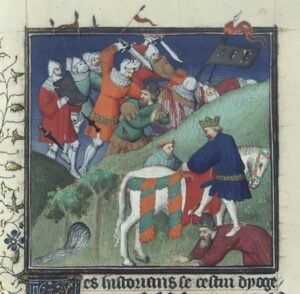
Image: Hassan-i Sabbah-1.jpg — Unknown authorUnknown author, Public domain