Why was the Battle of Badr fought?
The Battle of Badr grew from an attempt to seize a trading caravan into the first major pitched battle between the Muslims of Medina and the Quraysh of Mecca. Muhammad led the Muslim force. Abu Jahl, also known as Amr ibn Hisham, commanded the opposing army. The battle ended in a decisive Muslim victory in 624.
Its causes combined economic retaliation and a decision to demonstrate military strength. After the Muslims migrated from Mecca, property they had left there was seized. Attempts to intercept Quraysh caravans formed part of their response. Muhammad’s immediate target was the caravan that Abu Sufyan was bringing from Syria to Mecca.
The caravan escaped, but the army sent from Mecca continued toward Badr. That distinction explains why the battle happened. If you follow only the caravan, you miss the decision that turned the expedition into a confrontation: the Quraysh advanced even after learning that their trading party was safe.
Battle of Badr date: in what year was it fought?
The Battle of Badr was fought in 624. Its commonly accepted date is 17 Ramadan 2 AH, corresponding to 13 March 624.
The precise day has differing traditions. The TDV İslâm Ansiklopedisi records dates of 19, 21, and 27 Ramadan alongside the familiar 17 Ramadan dating. When you encounter different Ramadan dates, these recorded alternatives help explain the variation. The standard date used here is 17 Ramadan 2 AH.
Battle of Badr location: where did it happen?
The battlefield lay around the wells of Badr, southwest of Medina in the Hijaz. The battle took its name from Badr, now a town in Saudi Arabia’s Medina Province. For readers approaching the subject through travel in Turkey, this geographical distinction matters: the battlefield is in present-day Saudi Arabia.
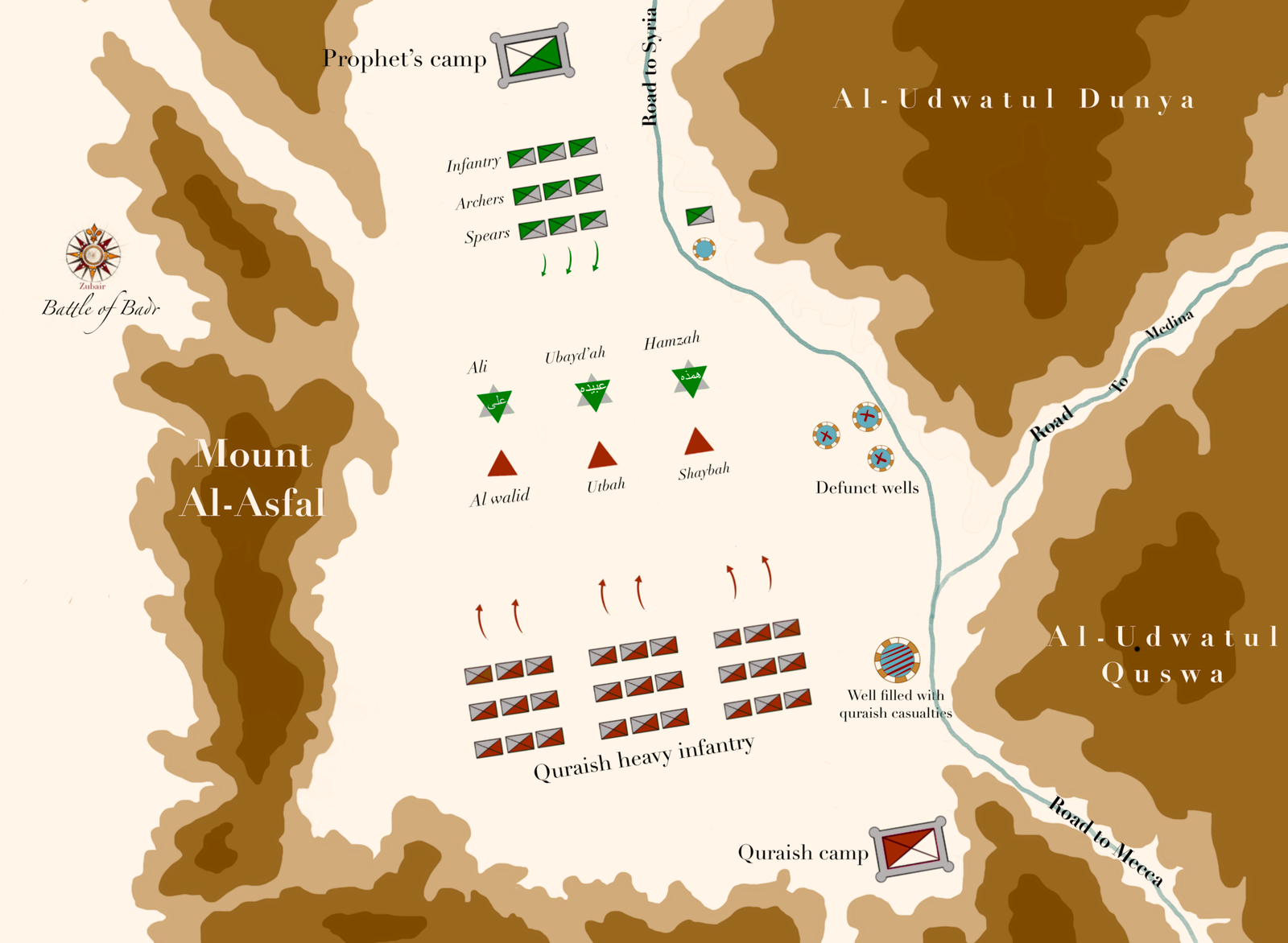
On a battle map, look for the Badr valley and its wells. Two large sandy elevations east of the valley appear under the names al-Udwat al-Dunya and al-Udwat al-Quswa. These features give you concrete landmarks for following the account, alongside Medina’s position northeast of the battlefield.
Water also enters the story through decisions at the wells. According to the account, some wells were closed following Hubab ibn Mundhir’s advice. Muhammad nevertheless allowed Quraysh men to take water from the well that remained open.
Battle of Badr story: from caravan interception to battle
Muhammad initially set out to capture Abu Sufyan’s caravan returning from Syria. Abu Sufyan responded in two ways. He sent Damdam ibn Amr to Mecca to request help. He also diverted the caravan onto the coastal route, allowing it to escape interception.
The Meccan army learned at al-Juhfa that the caravan was safe. It nevertheless continued toward Badr to show its strength to the Muslims. The original trading target had therefore escaped before the armies fought. The Quraysh decision to advance kept the confrontation moving toward battle.
The commonly repeated figures place 313 Muslims against about 1,000 Quraysh. TDV gives a more specific distinction: 305 Muslims actually participated, while eight absent men were counted as entitled to shares of the spoils. The familiar total of 313 therefore needs care when describing who was physically present.
The Muslim force had only two horses and seventy camels. These figures add a practical dimension to the numerical imbalance. Alongside the difference in manpower, the account records a small supply of animals for transport and fighting. Muhammad commanded this force against the larger army led by Abu Jahl.
The opening individual combats brought Hamza, Ali, and Ubayda ibn Harith forward from the Muslim side. Their Quraysh opponents were Utba, Shayba, and Walid. These named encounters form the opening combat episode in the battle’s story, before its decisive outcome in the defeat of the Quraysh army.
Timeline
- 624, before the battle: Muhammad set out to intercept Abu Sufyan’s caravan returning from Syria.
- 624, before the battle: Abu Sufyan diverted the caravan toward the coast and saved it. The Meccan army continued toward Badr.
- 17 Ramadan 2 AH / 13 March 624: According to the commonly accepted dating, the Battle of Badr took place and ended in Muslim victory.
- 624, after the battle: Some prisoners were released for ransom. The victory strengthened Muhammad’s political position.
Battle of Badr summary: outcome and prisoners
Badr ended with the rout of the Quraysh and a decisive victory for Muhammad’s force. The commonly reported casualty figures are 14 Muslims killed, 70 Quraysh killed, and another 70 Quraysh taken prisoner. Abu Jahl and Umayya ibn Khalaf were among the prominent Meccans killed.
The loss of Abu Jahl meant that the Quraysh commander was among the dead. The defeat also left the Muslims holding prisoners whose release became part of the aftermath. Some were freed for payments ranging from 1,000 to 4,000 dirhams, with the amount determined by their financial circumstances.
TDV also preserves an account concerning literate prisoners. Some were to receive their freedom on condition that each taught ten Muslims to read and write. Ransom payments and this teaching arrangement belong to the consequences of the same victory, though the teaching account is presented as a transmitted report.
Details you won’t find in guidebooks
According to a report, the Muslims estimated the Quraysh army’s size by asking how many camels it slaughtered each day. The answers supported an estimate of about 1,000 men. This connects military information with an everyday calculation: you can estimate the size of a gathering from the amount of food prepared.
The account of the wells contains another detail easily lost in a brief summary. Some wells were closed on Hubab ibn Mundhir’s advice, yet Muhammad permitted Quraysh access to the open well. Both actions belong in the account; mentioning only the closures leaves out the recorded permission to obtain water.
A further detail concerns the name of a Quranic chapter. Diyanet explains that Al Anfal was also called Badr because its revelation began during the battle and because it contains rules concerning warfare. The battle’s name thus appears in the religious tradition beyond the name of the battlefield itself.
The Battle of Badr in Islam and the Quran
Al Imran 123 mentions Badr by name and associates the Muslim victory with God’s help. This explicit reference gives the battle a place in the Quran as well as in accounts of Muhammad’s military and political career. Its religious significance rests partly on that connection between victory and divine assistance.
Interpretation of the assistance includes a debate about angels. In its commentary on Al Imran 124–125, Diyanet supports the view that angels actually fought at Badr. It rejects the interpretation that their help consisted only of moral encouragement. This is a specific interpretive position within the discussion of divine aid.
The victory also had a political consequence. It strengthened Muhammad’s position and made it easier for tribes outside Medina to form open alliances with him. If you want to understand Badr’s significance, connect these two strands: the Quran’s treatment of divine help and the victory’s effect on alliances beyond Medina.
FAQ
Why was the Battle of Badr fought?
Muhammad set out to intercept a Quraysh caravan against a background of retaliation for Muslim property seized in Mecca after the migration. The caravan escaped, but the Meccan army continued toward Badr to demonstrate its strength.
When was the Battle of Badr fought?
The commonly accepted date is 17 Ramadan 2 AH, corresponding to 13 March 624. TDV also records traditions placing it on 19, 21, or 27 Ramadan.
Where did the Battle of Badr happen?
It took place around the wells of Badr, southwest of Medina in the Hijaz. Badr is now a town in Saudi Arabia’s Medina Province.
Who won the Battle of Badr?
The Muslims under Muhammad decisively defeated the Quraysh army led by Abu Jahl. Commonly reported losses were 14 Muslims killed, with 70 Quraysh killed and 70 captured.
Where is Badr mentioned in the Quran?
Al Imran 123 names Badr and connects the Muslim victory with God’s help. Diyanet also explains that Al Anfal became known as Badr because its revelation began during the battle and it contains rules concerning warfare.
Sources
- Wikipedia — Battle of Badr en.wikipedia.org
- Vikipedi — Bedir Muharebesi tr.wikipedia.org
- Wikipedia — Badr, Medina Province en.wikipedia.org
- TDV İslâm Ansiklopedisi — Bedir Gazvesi islamansiklopedisi.org.tr
- Diyanet — Commentary on Al Imran 124–125 kuran.diyanet.gov.tr
- Diyanet — Introduction to Al Anfal kuran.diyanet.gov.tr
Image: The battle of Badr.png — DrZubairRashid, CC BY-SA 4.0