Uffizi Gallery: why this Renaissance collection matters
Botticelli, Leonardo da Vinci and Michelangelo all have paintings in the Uffizi Gallery. So do Giotto, Raffaello and Caravaggio. That concentration explains the appeal of the search phrase “Uffizi Gallery: the greatest Renaissance art collection.” The works themselves offer a firmer starting point than a ranking: mythological scenes, religious paintings and ancient sculpture share this museum in Florence.
You can begin with Botticelli’s Birth of Venus, then compare it with his Primavera. Leonardo’s Annunciation and Michelangelo’s Doni Tondo introduce different subjects, materials and formats. These objects give you concrete ways to approach Renaissance art. Dates, painted surfaces and dimensions become as useful as the artists’ names.
Uffizi Florence: where is the Uffizi museum?
The Uffizi stands beside Piazza della Signoria in Florence, in Italy’s Tuscany region. The gallery occupies the first and second floors of the building designed by Giorgio Vasari. Its location and architecture belong to the same story: Cosimo I de’ Medici commissioned a building for the city’s government offices.
The collection extends beyond paintings. Ancient statues and busts from the Medici collection occupy the corridors. Among them are Roman copies of lost Greek sculptures. As you move through the building, these objects introduce another kind of historical survival: a sculpture can preserve a form whose earlier version has disappeared.
Uffizi meaning: why an art gallery is called “offices”
The name Uffizi comes from the Italian word for “offices.” The building was intended for Florence’s administrative and judicial offices. Construction began in 1560 under Vasari. Its name therefore records its original practical purpose, even though paintings now define the gallery for many visitors.
Think of the everyday act of visiting an office to deal with administration. That ordinary connection helps explain the Uffizi’s name. Cosimo I’s commission concerned government business. The building’s later role as an art museum added another function to an architectural project that began with offices.
Vasari died in 1574. Alfonso Parigi and Bernardo Buontalenti continued the construction, which finished in 1580. The gallery’s establishment is dated to 1581. These dates describe different stages: the start of construction, the completion of the building and the establishment of the gallery.
How did the Medici collection remain in Florence?
Anna Maria Luisa de’ Medici secured the Medici art collections’ continued presence in Florence through the family agreement of 1737. This agreement is central to the gallery’s history. It connects the collection’s location with a deliberate decision about where the works should remain.
Pietro Leopoldo, Grand Duke of Tuscany, opened the Uffizi to the public in 1769. Public access therefore came much later than the building’s completion in 1580. When you consider the museum’s beginnings, it helps to keep those events separate. A completed building and a publicly accessible gallery mark different changes.
Uffizi Gallery famous works: what should you look at?
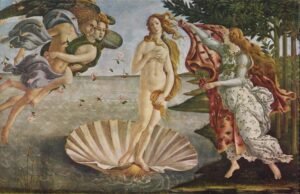
Botticelli’s Birth of Venus dates to around 1485. He painted it in tempera on canvas. It measures 172.5 × 278.5 centimetres. Those dimensions matter when you encounter a reproduction: the original is a broad canvas, with a width substantially greater than its height.
His Primavera, painted around 1480, uses tempera grassa on wood. It measures 207 × 319 centimetres. Nine figures from classical mythology appear in the painting. They include Venus, Cupid, Mercury and the Three Graces. Comparing the two Botticelli works gives you specific differences to follow: canvas and wood, different dimensions, and different arrangements of mythological figures.
Leonardo da Vinci’s Annunciation dates to around 1472. Painted in oil on wood, it measures 90 × 222 centimetres. The painting entered the Uffizi in 1867 from the Church of San Bartolomeo a Monteoliveto in Florence. Its history therefore includes both a church setting and its later place in the museum.
Michelangelo made the Doni Tondo for the Florentine merchant Agnolo Doni. The painting measures 120 centimetres in diameter. It is Michelangelo’s only surviving completed painting on a wooden panel. Its circular format gives you another clear point of comparison with the broad rectangular works by Leonardo and Botticelli.
Titian’s Venus of Urbino dates to 1538. This oil painting on canvas measures 119 × 165 centimetres. Alongside Botticelli’s Birth of Venus, it also makes the word “Venus” an insufficient identifier on its own. Artist and title help distinguish the two works in the Uffizi collection.
Uffizi: where is Venus, and where is Birth of Venus?
Botticelli’s Birth of Venus is in the Uffizi Gallery in Florence. If that is the painting you want to see, use its full title and Botticelli’s name. The collection also contains Titian’s Venus of Urbino, while Venus appears among the figures in Botticelli’s Primavera.
The title Birth of Venus can also shape your expectations of the scene. Botticelli depicts the goddess arriving at the shore of Cyprus on a shell. Looking for that arrival gives you a more precise understanding of the image than taking the title as a literal description of the moment shown.
Details you won’t find in guidebooks
The Romanesque Church of San Pier Scheraggio was preserved during the Uffizi’s construction and incorporated into the building. It continued to serve as a place of worship until the eighteenth century. The complex therefore held a functioning church within the building created for government offices.
The Medici Theatre inside the Uffizi later housed the Senate. This happened during Florence’s period as capital of the Kingdom of Italy, from 1865 to 1871. The building’s history includes administration, worship, art and parliamentary use. Those functions belong to different moments in its long occupation.
In Birth of Venus, Botticelli used gold to create reflected light in the goddess’s blond hair. The material is a useful detail to remember when looking closely at the painting. The highlights involve an application of gold within a work otherwise described as tempera on canvas.
Primavera contains at least 42 identified plant species, according to the Uffizi’s artwork description. These include 14 green plants and 28 flowering plants. After identifying its nine mythological figures, you can turn your attention to this botanical detail. The plants provide another concrete way to examine the painting.
Timeline
- Around 1472: Leonardo da Vinci paints Annunciation.
- Around 1480: Botticelli paints Primavera.
- Around 1485: Botticelli paints Birth of Venus.
- 1538: Titian paints Venus of Urbino.
- 1560: Construction of the Uffizi begins.
- 1574: Vasari dies; Parigi and Buontalenti continue the work.
- 1580: The Uffizi building is completed.
- 1581: The gallery’s establishment is dated to this year.
- 1737: The Medici family agreement secures the collections’ place in Florence.
- 1769: Pietro Leopoldo opens the gallery to the public.
- 1865–1871: The Medici Theatre houses the Senate.
- 1867: Leonardo’s Annunciation enters the Uffizi.
Uffizi Gallery tickets: prices and visiting arrangements
According to the official tariff checked on 25 October 2026, standard single admission costs €25 when purchased on the day of the visit. Buying beforehand costs €29. The official visitor page directs online purchases to tickets.uffizi.it. You can also buy tickets at the counters beneath the museum’s porticoes or through the international call centre on +39 055 0354135.
The standard schedule checked on 25 October 2026 gives opening hours of Tuesday to Sunday, 08:15–18:30. The ticket office closes at 17:30. Standard closure days are Mondays, 1 January and 25 December. The ticket-office closing time is therefore earlier than the gallery’s closing time.
If your visit includes the Vasari Corridor, the official arrangement requires entry to the Uffizi two hours before the corridor appointment. The corridor visit lasts about 45 minutes. Its route runs in one direction. Once you enter it, you cannot return to the Uffizi rooms, so this sequence matters when arranging your time with the paintings.
Uffizi Galleries photos: which works should you identify?
For images of individual paintings, the official artwork pages listed below provide a starting point. Identify each work by artist and full title: Botticelli’s Birth of Venus and Primavera, Leonardo’s Annunciation, Michelangelo’s Doni Tondo, and Titian’s Venus of Urbino. Their recorded materials and dimensions also help you understand what a photograph represents.
FAQ
Where is the Uffizi Gallery?
The Uffizi Gallery stands beside Piazza della Signoria in Florence, in Italy’s Tuscany region.
What does Uffizi mean?
Uffizi means offices. The building was originally designed for Florence’s administrative and judicial offices.
Where is Botticelli’s Birth of Venus?
Botticelli’s Birth of Venus belongs to the Uffizi Gallery in Florence. Painted around 1485, it depicts Venus arriving at the shore of Cyprus on a shell.
How much are Uffizi tickets?
According to the official tariff checked on 25 October 2026, standard single admission costs €25 when purchased on the visit day or €29 when purchased beforehand.
Sources
- Wikipedia — Uffizi en.wikipedia.org
- Vikipedi — Uffizi Galerisi tr.wikipedia.org
- Uffizi Galleries — Storia | Gli Uffizi uffizi.it
- Uffizi Galleries — The Uffizi uffizi.it
- Uffizi Galleries — Birth of Venus uffizi.it
- Uffizi Galleries — Spring uffizi.it
- Uffizi Galleries — Annunciation uffizi.it
- Uffizi Galleries — Holy Family, known as the Doni Tondo uffizi.it
- Uffizi Galleries — Venus of Urbino uffizi.it
- Uffizi Galleries — Visit uffizi.it
- Uffizi Galleries — Rules for accessing the Vasari Corridor uffizi.it
Image: Sandro Botticelli – La nascita di Venere – Google Art Project – edited.jpg — Sandro Botticelli, Public domain