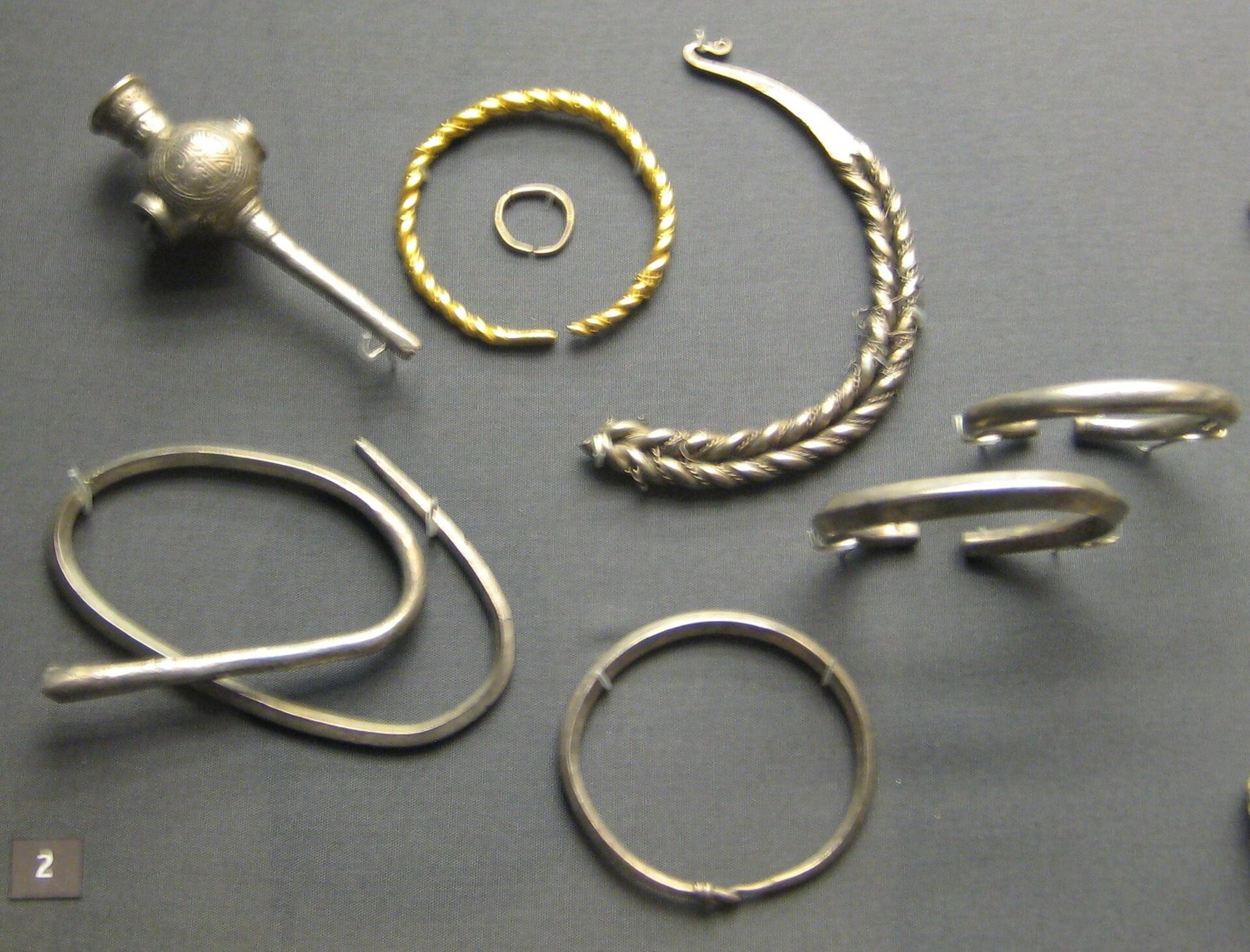
The 1,100-year-old Viking finds on the Isle of Man may have belonged to early Scandinavian settlers around AD 900, according to Manx National Heritage. Oval brooches associated with women’s clothing and a decorated sword traditionally associated with men suggest a possible double burial, although separate graves from the same period remain possible.
The objects bring several parts of those settlers’ lives into view: clothing, weapons, trade and perhaps ceremonial gatherings. If you follow the evidence from the brooches to the weighing equipment, the ownership question becomes more interesting than a search for a single warrior. Each object contributes something different to the interpretation.
Who might have owned these Viking objects?
Manx National Heritage links the finds with the island’s early Scandinavian settlers. Vikings reached the Isle of Man during the ninth century, first establishing trading connections and then settling. The new group dates to about AD 900, placing it within that early settlement history.
The word “Viking” does not identify one nationality. It encompasses Scandinavian peoples, including Danes, Norwegians and Swedes. The Viking Age is generally dated to approximately AD 800–1050, and its activities included trade and settlement. Those distinctions matter here because the finds contain commercial equipment alongside a sword and an axe head.
The strongest interpretation therefore concerns a community and period: early Scandinavian settlement around AD 900. The brooches help researchers consider the presence of women. The weapons contribute to the burial interpretation. The weights and balance parts add evidence of trading activity. Together, they support a broader picture than the sword alone could provide.
What was found on the Isle of Man?
Daniel Crowe discovered the group with a metal detector in February 2026. It includes three bronze brooches, a Viking sword, trading weights, balance parts, a bronze ladle and an axe head. Rhett Britton also participated in the search. He found the Viking axe head, part of the balance and additional iron objects.
Two of the bronze brooches are oval and decorated with interlacing animal figures. The third was originally gilded. It has spiral decoration around a glass centre and is the first recorded example of its type on the island. These are distinct pieces, even though all three belong to the same discovery group.
The sword is the thirteenth Viking sword found on the Isle of Man. The trading weights are the island’s first finds of their kind. No earlier example of this type of bronze ladle had been recorded there either. The objects received formal Treasure status from the island’s Coroner for Inquests because of their historical and archaeological importance.
Why do the oval brooches suggest a woman’s burial?
Oval brooches fastened an apron-like outer garment worn by women. Manx National Heritage describes their fastening positions at the shoulders and front. Their role was practical as well as decorative. When you examine the animal patterns, you are also looking at fittings that once helped hold clothing in place.
Museum archaeology curator Allison Fox suggests that the newly discovered brooches could provide evidence of the earliest known Viking Age female burial on the Isle of Man. That is an interpretation of the objects and their context. It is more specific than simply identifying them as Viking ornaments.
The new pair may be about 50 years older than the island’s only previously discovered pair of oval brooches. That earlier pair was found in December 2018 and dated by the museum to approximately AD 900–950. Both the dating and the proposed difference are approximate, so the comparison should not be treated as an exact interval.
Was this a double burial?
The double burial theory comes from the combination of objects. The oval brooches are associated with women’s clothing. The sword is traditionally associated with men. Their discovery together prompted the museum to consider whether the group represented the burial of two people.
The burial area, however, has been disturbed during the last thousand years. The objects’ original placement cannot be established with certainty. Manx National Heritage therefore also allows for separate graves from the same period. A group recovered together does not automatically establish that every object entered the ground in one burial.
If you picture two people buried side by side, keep that image provisional. The brooches and sword support the possibility, but the disturbed setting leaves another explanation open. The distinction matters because a double burial and separate contemporary graves imply different arrangements of the same surviving evidence.
What do the sword and trading equipment reveal?
About two-thirds of the sword survives. X-ray examination revealed fine silver inlay and twisted silver-wire decoration on its hilt. Only two other Viking swords with similar decoration are known from the Isle of Man. Those details make the surviving weapon useful for comparison with other island finds.
The museum suggests that the sword may have been broken during the burial ritual. It also identifies additional damage that occurred after burial. These are separate parts of the interpretation. The possibility of deliberate ritual breakage should not turn every damaged part of the sword into evidence of the ceremony.
The decorated lead weights and bronze balance parts had a commercial purpose. They were used to weigh precious metals and coins. An everyday connection is the act of checking a purchase by weight: the comparison helps you understand why a balance mattered. Here, the objects specifically concern the measurement of valuable metals and money in trade.
The bronze ladle introduces another possibility. It may have been used at feasts or ceremonies. That proposed use remains less certain than the weighing function of the commercial equipment. Read together, the ladle, weights and weapons suggest several activities associated with the owners, without establishing a single occupation for them.
Details you won’t find in guidebooks
The two discoveries have a family connection. John Crowe, who found the earlier oval brooch pair with Craig Evans in December 2018, is Daniel Crowe’s father. The relationship links the people who recovered the objects. It does not establish any relationship between their Viking Age owners.
One trading weight contains a bronze decorative fitting that may have been reused. The museum suggests that it could originally have come from a small chest or a religious object. If that interpretation is correct, the fitting had an earlier function before becoming part of the weighing equipment.
Daniel Crowe did not clean the objects after finding them. That decision helped preserve archaeological traces that might otherwise have disappeared before specialist examination. The significance of the discovery therefore rests partly on what survived on the objects, alongside their shapes, materials and decoration.
How do the finds affect ideas about Viking settlement?
Dirk Steinforth’s 2026 article discusses an older theory that Scandinavian settlement on the Isle of Man involved groups of male warriors who married local Christian women. That theory concerned who migrated to the island, rather than merely which objects appeared in its graves.
According to Steinforth, the model of exclusively male settler groups was challenged in 2015. The oval brooches discovered in 2018 strengthened the case for the presence of Scandinavian women. The newly found pair adds another possible early female burial to that discussion. Its significance extends beyond the proposed double burial itself.
The trading equipment also fits the settlement context described by Manx National Heritage: commercial connections came before settlement. Weights and balance parts give that account a concrete form. They help explain why these finds belong in a discussion of settlers and their economic connections, alongside the evidence supplied by weapons and clothing fittings.
Timeline
- Ninth century: Vikings established trading connections with the Isle of Man and subsequently settled there.
- Around AD 900: The newly discovered object group dates to this period.
- Around AD 900–950: The museum’s proposed date range for the earlier oval brooch pair.
- December 2018: John Crowe and Craig Evans found the island’s first known pair of oval brooches.
- February 2026: Daniel Crowe discovered the new Viking object group.
- 10 November 2026: ITV reported the discovery.
- 11 November 2026: The announced starting date for a selection of the finds to be displayed in the Manx Museum’s Viking Gallery.
FAQ
Who might have owned the Viking finds on the Isle of Man?
Manx National Heritage suggests that the objects belonged to early Scandinavian settlers around AD 900. Brooches associated with women’s clothing and a sword traditionally associated with men raise the possibility of a double burial.
Do the objects prove there was a double burial?
A double burial is one interpretation. The burial area was disturbed, so separate graves from the same period remain possible.
What do the weights and balance parts reveal?
They were used to weigh precious metals and coins in trade. Their presence connects the objects with economic activity as well as burial practices.
Where was a display of the finds announced?
A selection was announced for display in the Manx Museum’s Viking Gallery from 11 November 2026.
Sources
- Vikipedi — Vikingler tr.wikipedia.org
- Wikipedia — Viking Age en.wikipedia.org
- Manx National Heritage — Viking Brooches Declared Treasure manxnationalheritage.im
- Isle of Man Today — Meet the man who discovered Viking treasure iomtoday.co.im
- ITV News Granada — 1,100-year-old Viking burial itv.com
- Isle of Man Today — Extraordinary Viking treasure discovered iomtoday.co.im
- Manx National Heritage — Rare 1,100-Year-Old Viking Double Burial manxnationalheritage.im
- Manx Radio — Amazing Viking treasure offers new clues manxradio.com
- AmS-Skrifter — Dirk Steinforth, Viking Man, Viking women journals.uis.no
Image: British Museum Ballaquayle Hoard.jpg — Wikimedia Commons, CC0