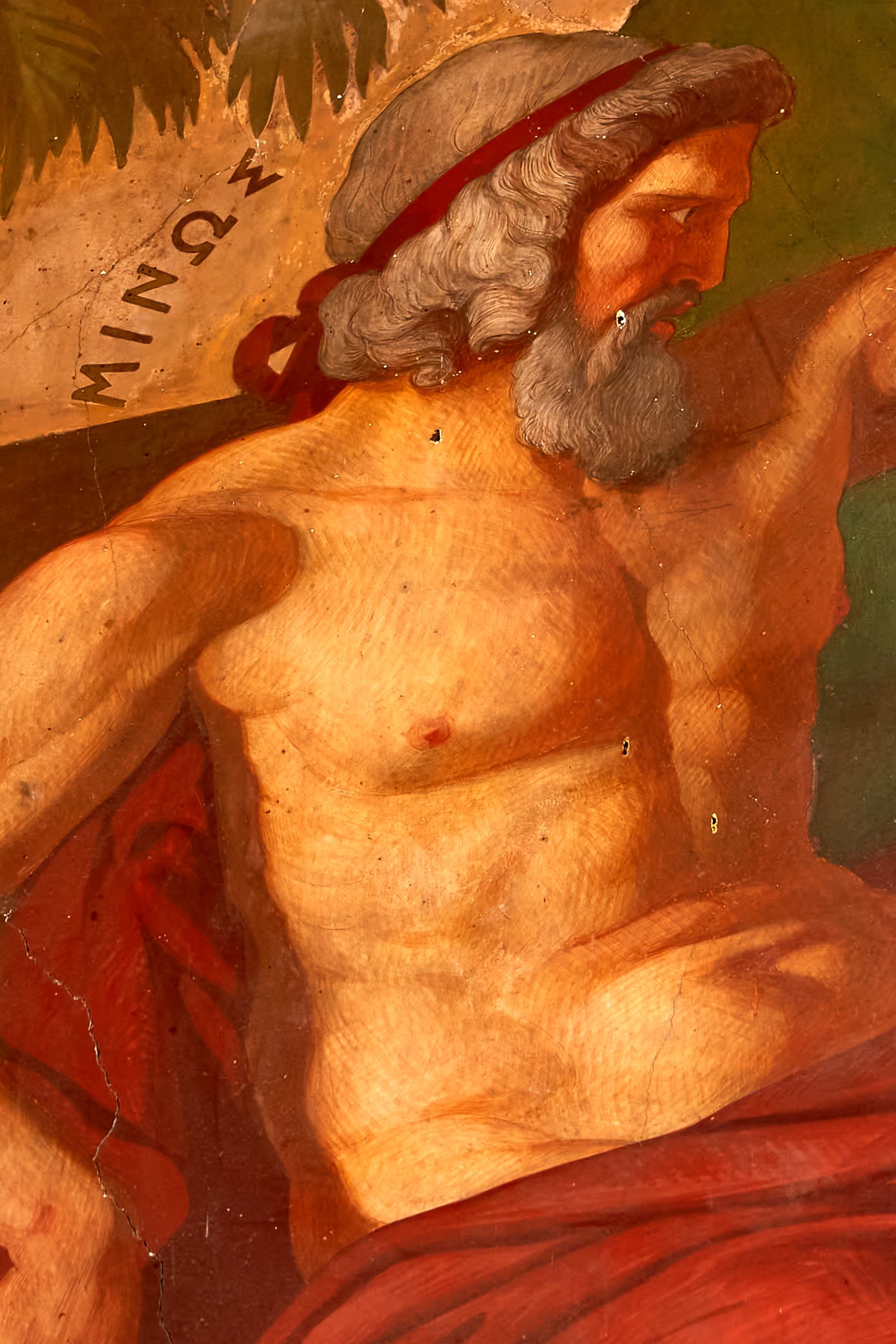
King Minos has not been confirmed as a particular historical king. Ancient sources portray the legendary ruler of Crete as a lawgiver, a naval ruler, a cruel king, and a judge of the dead. Crete’s Bronze Age palaces are archaeological realities, but they do not establish that Minos himself existed.
Why does the same king receive laws from Zeus and send young Athenians to the Minotaur? That tension runs through the Minos tradition. If you follow the ancient accounts alongside the remains at Knossos, you can distinguish the king of myth from the buildings later associated with his name.
How is Minos portrayed as a king in ancient myths?
Greek mythology makes Minos the son of Zeus and Europa and the legendary king of Crete. His connection with Zeus also supports his role as a lawgiver. In this tradition, royal authority rests on laws learned from a god.
Another tradition presents a cruel ruler. Minos compels Athens to send young people who become victims of the Minotaur. The king who receives divine laws therefore also appears as a tyrant whose power brings suffering to another community.
Later ancient writers tried to reconcile these conflicting portraits. Diodorus and others proposed two separate kings called Minos. This explanation allowed different characters and generations to be assigned to different rulers. It remains a theory for reconciling the traditions, rather than confirmation that two historical kings existed.
The distinction matters when you encounter a description of Minos as either wise or brutal. Both portraits belong to the surviving tradition. Choosing one and treating it as a straightforward royal biography removes the contradiction that later ancient writers themselves tried to explain.
Does Thucydides’ account of Minos’ naval power constitute historical evidence?
In his History of the Peloponnesian War, 1.4.1, Thucydides introduces Minos as the earliest person known through tradition to have acquired a navy. His wording identifies the basis of the account. He is reporting what has been handed down about the king.
Thucydides gives that naval power a territorial setting. Minos removes the Carians from the Cyclades and installs his own sons as rulers. The passage connects ships with control over islands and the placement of members of the royal family in power.
He also connects the suppression of piracy with revenue. Thucydides explains that Minos sought to make the collection of his income more secure. He marks this motive as an inference. The passage therefore combines inherited information with the historian’s explanation of how naval power served a ruler’s interests.
This is historical evidence for the existence of a Minos tradition. It does not independently verify Minos as a historical individual. The account’s explicit reliance on inherited reports limits what it can establish about the king himself.
The age of that maritime tradition is also debated. Chester Starr and some other researchers proposed that Minos’s Aegean sea power was a construction shaped in fifth-century BCE Athens. Under this interpretation, the naval king reflects a later conception of maritime rule.
Valerio Caldesi Valeri argues that archaic and non-Athenian traditions connect Minos with sea power before the fifth century BCE. His conference abstract places the tradition of Minos colonizing Keos, found in Bacchylides’ first victory song, before 480 BCE. This challenges a fifth-century origin for the connection. It still does not establish the king’s personal existence.
How do the Labyrinth, Minotaur and underworld judge traditions connect?
In Pseudo-Apollodorus’s Bibliotheca, 3.8–11, the Minotaur story begins with a broken promise. Poseidon sends Minos a bull from the sea. Minos promises to sacrifice it, then substitutes another animal.
Poseidon’s punishment brings the consequences into the royal household. Pasiphae falls in love with the bull. After she uses a wooden cow constructed by Daedalus, the bull-headed Minotaur is born. In this account, the monster’s birth follows Minos’s failure to fulfill his promise to the god.
The familiar Labyrinth tradition gives Daedalus another commission. Minos orders him to build the Labyrinth at Knossos to confine the Minotaur. The king’s power now appears through a structure that contains the creature and becomes the setting for the fate of the Athenian victims.
Plutarch’s Theseus, chapter 15, describes an agreement requiring Athens to send seven young men and seven young women to Minos every nine years. Theseus eventually kills the Minotaur. Ariadne, Minos’s daughter, gives him the thread that enables him to find his way out of the Labyrinth.
Minos also exercises authority after death. In the Odyssey, 11.568–571, Homer shows him seated in Hades with a golden sceptre. The dead gather around him as he gives judgments in their disputes. This portrait places his royal authority within the world of the dead.
Plato’s Gorgias, 523e–524a, gives him a further judicial role. Zeus appoints Minos, Rhadamanthys, and Aeacus as judges after death. Minos makes the final decision when the other two are uncertain. The traditions connect through the same figure of authority, although they assign him very different uses of power.
Why is the term Minoan used, and does it prove that a particular king existed?
Arthur Evans named Crete’s Bronze Age culture Minoan after the legendary King Minos. The term identifies a culture through a name drawn from mythology. Its use does not turn the legendary king into an archaeologically confirmed person.
Large palace centres developed on Crete around 1900 BCE. Buildings at Knossos, Malia, Phaistos, and Zakros concentrated political and economic power. These structures provide concrete evidence for palace centres on the island, independently of the question of Minos’s existence.
Evans uncovered the complex building at Knossos between 1900 and 1904 and called it the Palace of Minos. He also identified it with the legendary Labyrinth. Frescoes showing people leaping over bulls helped support his interpretation. The building is archaeological evidence; its identification with the myth is an interpretation of that evidence.
Think of the everyday difference between a building’s familiar name and proof of who lived there. Palace of Minos is the name applied to the Knossos structure in modern literature. You cannot use that name alone to identify its occupant as the legendary king.
The surviving writing also requires care. According to Ester Salgarella’s study, Linear A was used around 1800–1450 BCE and remains undeciphered. The surviving documents are mainly economic and cultic. Their use for historical writing or literature has not been demonstrated.
Timeline
- Around 1900 BCE: Large palace centres develop on Crete, including Knossos. This archaeological date is not a date for Minos’s reign.
- Around 1800–1450 BCE: Linear A is in use.
- Before 480 BCE: Valeri places the tradition of Minos colonizing Keos before this date.
- 300–200 BCE: A Knossos coin now in the Ashmolean collection carries a labyrinth design.
- 1900–1904: Evans uncovers the Knossos building he calls the Palace of Minos.
Details you won’t find in guidebooks
The Minotaur has a personal name in Pseudo-Apollodorus: Asterios. Minotauros means the bull of Minos. The familiar name therefore expresses the creature’s association with the king, while Asterios identifies the creature individually.
Homer’s Iliad mentions a dancing place that Daedalus made for Ariadne at Knossos. It does not mention the Labyrinth. Daedalus, Ariadne, and Knossos thus appear together in this passage without the structure central to the familiar Minotaur story.
The Ashmolean’s Knossos coin, dated 300–200 BCE, offers another detail. Its labyrinth design has a single route to the centre. It does not show a branching network in which someone could choose a wrong turning and become lost.
Pliny the Elder describes the Cretan Labyrinth as inspired by the labyrinth in Egypt. He also states that nothing remained of the Cretan structure in his own time. His account preserves an ancient description of the Labyrinth rather than surviving remains he could identify there.
Evans’s chronological system also had a model. He divided Early, Middle, and Late Minoan periods into three subdivisions each. This nine-part arrangement roughly followed Egypt’s division into Old, Middle, and New Kingdoms.
What should you understand when visiting Knossos?
Knossos lies about five kilometres south of the historic centre of modern Heraklion on Crete. It is an ancient settlement associated with the Minos legends. The location gives you a real archaeological place to connect with the stories, while the historical identity of Minos remains unconfirmed.
UNESCO’s Minoan Palatial Centres designation covers six archaeological sites dated to 1900–1100 BCE. They are Knossos, Phaistos, Malia, Zakros, Zominthos, and Kydonia. This wider group places Knossos within the archaeology of Crete’s palace centres, beyond its association with a single legendary king.
FAQ
Did King Minos really exist?
Minos has not been confirmed as a particular historical king. Ancient accounts preserve traditions about him, while the archaeological remains at Knossos do not establish his personal existence.
Was the Labyrinth a real building?
Myth describes a Labyrinth built by Daedalus at Knossos. Arthur Evans identified the complex palace there with the legendary Labyrinth, but that identification is an interpretation.
What does Thucydides say about Minos?
Thucydides presents Minos as the earliest ruler known through tradition to have acquired a navy. He also describes Minos removing the Carians from the Cyclades and installing his sons as rulers.
Does the name Minoan prove that Minos existed?
No. Arthur Evans named Crete’s Bronze Age culture after the legendary king. The archaeological label does not confirm a ruler with that name.
Sources
- Wikipedia — Minos en.wikipedia.org
- Vikipedi — Minos tr.wikipedia.org
- Perseus / Tufts University — Thucydides, History of the Peloponnesian War 1.4.1 beta.perseus.tufts.edu
- Society for Classical Studies — Valerio Caldesi Valeri, From Athenian Thalassocracy to Minos’ Sea Power: Archaic and Non-Athenian Traditions classicalstudies.org
- Theoi — Minotauros, ancient source excerpts theoi.com
- Ashmolean Museum — Myths of the Labyrinth ashmolean.web.ox.ac.uk
- Perseus / Tufts University — Homer, Odyssey 11 atlas.perseus.tufts.edu
- Ad Fontes Library — Plato, Gorgias adfonteslibrary.org
- The Metropolitan Museum of Art — Minoan Crete metmuseum.org
- University of Cambridge Repository — Ester Salgarella, Linear A repository.cam.ac.uk
- UNESCO World Heritage Centre — Minoan Palatial Centres whc.unesco.org
- Wikipedia — Knossos en.wikipedia.org
Image: Mural of Minos at the National And Kapodistrian University of Athens on May 22, 2022.jpg — George E. Koronaios, CC BY-SA 4.0