Type the name of this epic into a search box and the first result is usually a flood. One clay tablet from Nineveh carries a story of a boat, a storm, and a raven that never came back. George Smith presented that story to the Society of Biblical Archaeology in London on 3 December 1872. The comparison with Genesis has not stopped since. Yet the tablet from Nineveh is neither the oldest version of the epic nor the oldest flood text from Mesopotamia. This article sorts out what the Epic of Gilgamesh is, how old it is, what Tablet XI actually says, and where you can read or see it today.
Epic of Gilgamesh summary: the full story in brief
The Epic of Gilgamesh is a Mesopotamian poem about the adventures of Gilgamesh, king of Uruk. It began as separate Sumerian stories and later grew into a single Akkadian narrative. Uruk itself is a real place. It is the site of Warka in southern Iraq, one of the long-term excavation sites of the German Archaeological Institute.
The first half of the story is about friendship and action. Gilgamesh and Enkidu become friends. Together they kill Humbaba, the guardian of the Cedar Forest, and then the Bull of Heaven sent by Ishtar. Then Enkidu dies.
The second half is about death. Grieving, Gilgamesh travels to Utnapishtim, the survivor of the flood, to seek immortality. He fails. He returns to Uruk and seeks the lasting legacy of a human being in what he has built. The flood is a story inside this story. Utnapishtim tells it to his visitor in Tablet XI.
Epic of Gilgamesh age: how old is the text?
There is no single date. The material comes in layers.
Five Sumerian poems about Gilgamesh exist, and some of them go back to the Third Dynasty of Ur around 2100 BC. The combined epic survives in an Old Babylonian form dated to the 18th century BC. That version is known by its opening words, Surpassing All Other Kings. The Standard Babylonian version, arranged on 12 tablets, opens with the words He Who Saw the Deep.
Who wrote it? According to Andrew George, the poet of the first Akkadian epic is anonymous. Babylonian tradition credited the later standard text to a scholar from Uruk named Sîn-lēqi-unninni.
Was Gilgamesh real? The historical-person theory treats him as a king of Uruk who lived around 2700 BC. The Metropolitan Museum notes that no confirming evidence survives from his own lifetime. So the honest answer is: possibly, but unproven.
Epic of Gilgamesh in Sumerian
Before the Akkadian epic, there were Sumerian tales. Oxford University’s ETCSL catalogue gives free access to transliterations and English translations of five of them: Gilgamesh and Aga, the Bull of Heaven, Huwawa, the Netherworld, and the Death of Gilgamesh.
If you read Turkish, there is a printed option. Türkiye İş Bankası Kültür Yayınları published Gılgamış Hikâyeleri in 2019, translated by Selim F. Adalı and Ali T. Görgü. It runs 152 pages (ISBN 9786052957899). Instead of the combined Babylonian epic, it contains the five Sumerian narratives that fed into it, plus the Babylonian text known as the Letter of Gilgamesh.
Epic of Gilgamesh flood: what Tablet XI says
The flood appears in Tablet XI. Utnapishtim, the survivor, tells Gilgamesh his past. The gods decide to send a flood. Utnapishtim builds a boat. He loads his family, craftsmen, domestic animals and wild animals onto it.
After the storm, he tests whether land has appeared. He releases a dove. It returns. He releases a swallow. It returns. He releases a raven. The raven does not come back. That is the sign the water has gone down. Anyone who has read Genesis will notice the resemblance. That resemblance is what made the 1872 reading such news.
Is Gilgamesh really the oldest source of the flood story?
Calling Gilgamesh the definitive first source of the flood story is misleading. Two other texts compete.
The first is Atrahasis. The Morgan Library and Museum holds an Atrahasis tablet from the 17th century BC. The museum’s catalogue describes it as the oldest known Akkadian copy of the flood narrative. That is earlier than the 7th-century BC Flood Tablet from Nineveh.
The second is a separate Sumerian flood story, published by Oxford’s ETCSL. There the surviving hero is named Ziusudra, and the storm that rocks the great boat lasts seven days and seven nights.
How do these texts relate? Alan Millard’s study of the Atrahasis Epic argues that some flood passages in Gilgamesh and Atrahasis are identical, and that the Gilgamesh text most probably took them from Atrahasis. On the link to the Bible, John Azzopardi’s 1981 study accepts a relationship between Genesis and Gilgamesh but rejects the view that Genesis depends directly on Gilgamesh.
So the fair wording is this: Tablet XI is one of the most famous ancient flood accounts, not a proven first source.
Epic of Gilgamesh: where is it?
Not in one museum. The tablets are scattered.
The famous Flood Tablet, numbered K.3375, was found at the Kuyunjik site at Nineveh and belongs to the British Museum in London. It is a 7th-century BC clay tablet. The Library of Ashurbanipal tablets were excavated in the early 1850s by Austen Henry Layard, Hormuzd Rassam and W. K. Loftus.
Other witnesses sit elsewhere. An Akkadian Tablet II witness found at Uruk, catalogued as IM 076941, is in the Iraq Museum in Baghdad. Copies of the epic have also turned up at Hattusa in Anatolia, at Emar in Syria and at Megiddo in the Levant. If you are travelling in Turkey, Hattusa is the find-spot closest to you.
Timeline
- c. 2700 BC: the period in which Gilgamesh may have lived, if he was a historical person.
- c. 2100 BC: the Ur III period, where some independent Sumerian Gilgamesh poems originate.
- 18th century BC: the surviving Old Babylonian form of the combined Akkadian epic.
- 17th century BC: the Atrahasis flood tablet MLC 1889 in the Morgan Library is copied.
- 7th century BC: the K.3375 Flood Tablet from the Library of Ashurbanipal is produced.
- Early 1850s: excavation of the Ashurbanipal Library tablets at Nineveh.
- 3 December 1872: George Smith presents the flood narrative in London.
- 1999: Andrew George’s The Epic of Gilgamesh: A New Translation is published.
- 2019: İş Bankası Kültür Yayınları publishes the 152-page Gılgamış Hikâyeleri.
Details you won’t find in guidebooks
The Flood Tablet is small. K.3375 measures only 15.24 × 13.33 × 3.17 centimetres. The object that caused a sensation in 1872 fits in one hand.
A scribe signed off with a date. The Morgan’s Atrahasis tablet MLC 1889 carries a note by its copyist, Azag-Aya. He recorded finishing the work on the 28th day of the month Shebat in the 11th regnal year of Ammi-zaduga. Think of it as the date stamp you add when you save a document at work.
Three birds, not one. The dove, swallow and raven sequence is in Tablet XI. Many retellings compress it to a single bird.
That lion-wrestling hero is probably not Gilgamesh. Bearded heroes fighting lions on ancient seals are often labelled Gilgamesh. The Metropolitan Museum says this identification is unreliable. The figures are more often linked to the god Lahmu.
Epic of Gilgamesh: where to read it (full text, PDF, book)
You do not need to buy anything to start.
- Sumerian poems, free: Oxford’s ETCSL catalogue has the five Sumerian Gilgamesh narratives with transliteration and English translation.
- Sumerian Flood Story, free: also on ETCSL, text t.1.7.4.
- Critical edition, PDF: the University of Central Florida’s open educational resources catalogue links to an open-access download of Andrew George’s critical edition of Gilgamesh.
- Popular translation, book: Andrew George’s The Epic of Gilgamesh: A New Translation (1999) is recorded in the SOAS archive as 225 pages. The PDF offered there is a sample of pages 1 to 29 only, not the full text.
- Turkish, book: Gılgamış Hikâyeleri (İş Bankası Kültür Yayınları, 2019), 152 pages, for the Sumerian stories.
The Flood Tablet itself can be viewed online through the British Museum’s entry on Google Arts & Culture.
Epic of Gilgamesh movie
The film Gilgamesh: She Who Saw the Deep (2022) by Pelin Tan and Anton Vidokle runs 47 minutes.
FAQ
Is the Epic of Gilgamesh the oldest flood story?
Not with certainty. The Morgan Library’s 17th-century BC Atrahasis tablet is catalogued as the oldest known Akkadian copy of the flood narrative, and a separate Sumerian Flood Story with the hero Ziusudra also exists.
Where is the Gilgamesh Flood Tablet?
Tablet K.3375 is in the British Museum in London. It was found at the Kuyunjik site at Nineveh and dates to the 7th century BC.
How many tablets does the epic have?
The Standard Babylonian version was transmitted in a 12-tablet arrangement. The flood story is on Tablet XI.
Can I read the Epic of Gilgamesh for free?
Yes. Oxford’s ETCSL offers the five Sumerian Gilgamesh poems, and the University of Central Florida catalogue links to an open-access copy of Andrew George’s critical edition.
Was Gilgamesh a real king?
One theory places him in Uruk around 2700 BC. The Metropolitan Museum notes that no confirming evidence survives from his own lifetime.
Sources
- Wikipedia — Epic of Gilgamesh en.wikipedia.org
- Vikipedi — Gılgamış Destanı tr.wikipedia.org
- British Museum — The Flood Tablet (Google Arts & Culture) artsandculture.google.com
- Metropolitan Museum of Art — Gilgamesh metmuseum.org
- Morgan Library & Museum — The Deluge Story themorgan.org
- Oxford University — ETCSL, The Flood Story etcsl.orinst.ox.ac.uk
- Oxford University — ETCSL Catalogue etcsl.orinst.ox.ac.uk
- SOAS — Andrew George, The Epic of Gilgamesh eprints.soas.ac.uk
- SOAS — Alan Millard, The Atrahasis Epic eprints.soas.ac.uk
- University of Malta — The Flood in Genesis and the Epic of Gilgamesh um.edu.mt
- Humanities and Social Sciences Communications — Rediscovering Gilgamesh nature.com
- German Archaeological Institute — Uruk-Warka Collection dainst.org
- Cuneiform Digital Library Initiative — Gilgamesh II 057 cdli.earth
- University of Central Florida — Gilgamesh stars.library.ucf.edu
- SOAS Repository — The Epic of Gilgamesh: A New Translation soas-repository.worktribe.com
- Türkiye İş Bankası Kültür Yayınları — Gılgamış Hikâyeleri iskultur.com.tr
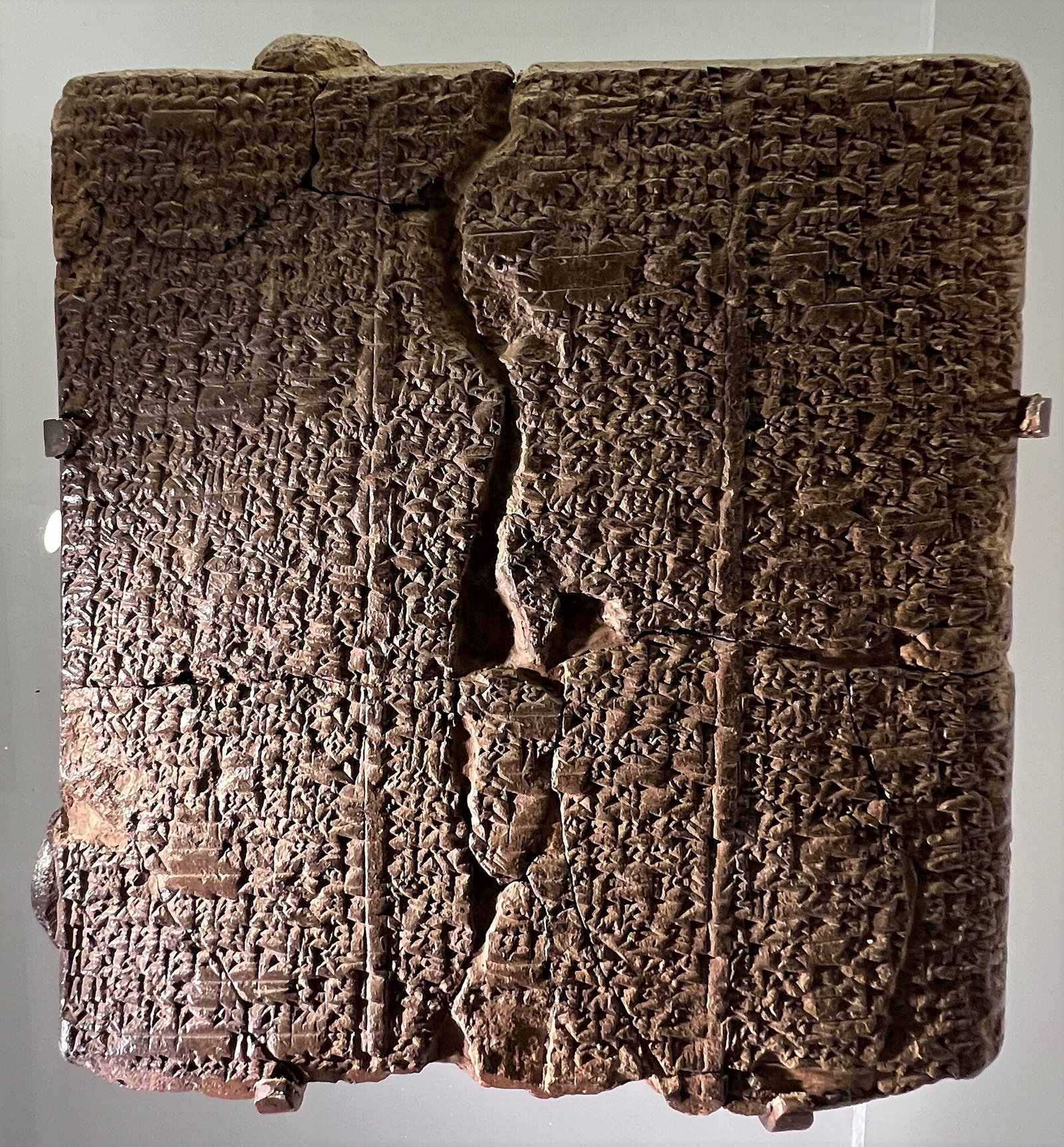
Image: CBS7771 Gilgamesh Epic Penn Museum.jpg — Onceinawhile, CC BY-SA 4.0