A boomerang is a curved throwing tool used by Aboriginal communities in Australia for hunting and other purposes, with both returning and non-returning forms. Returning boomerangs curve back because their wing-shaped arms produce unequal lift, creating torque that changes their spinning axis through gyroscopic precession. Most Aboriginal boomerangs, however, do not return.
A returning flight is only one part of this history. Boomerangs also helped hunters direct ducks into nets, supplied percussion for music and dance, and travelled along inland trade routes. If you follow their materials, flight and uses, you encounter both ancient wooden finds in Australia and a mammoth-ivory example from Poland.
What is a boomerang?
The English word “boomerang” comes from an Aboriginal language of the Sydney region. The name covers tools with different forms and purposes. Some were designed for returning flight. Others served as hunting weapons or implements for tasks that required no return at all.
The National Museum of Australia states that the great majority of Aboriginal boomerangs are non-returning. That distinction matters when you picture the object. A curved outline does not tell you whether a particular example was intended to circle through the air or perform another task.
Traditional wooden boomerangs were made from hardwoods, including acacia and eucalyptus. According to the Powerhouse Museum, makers selected a branch or root and shaped the wood through heating or moistening. The material and the shaping process belong to the object’s history just as much as its flight.
Why does a boomerang return?
Curvature alone does not explain a returning boomerang. The surface shape of its arms is another essential feature. Those surfaces form wing profiles. To understand the flight, you need to consider that shape together with the boomerang’s forward movement and spin.
As a returning boomerang spins, one arm moves in the direction of forward travel while the other moves against it. The advancing arm travels faster relative to the air. This difference produces more lift on that arm than on the opposing one.
The unequal lift creates torque. Because the boomerang is spinning, that torque changes the direction of its spinning axis through gyroscopic precession. This change bends the flight path. The return therefore depends on linked effects: wing-shaped surfaces, unequal lift and the response of a rotating object.
The Australian Museum describes a typical right-handed throw as beginning with the boomerang held approximately upright. During its left-curving flight, the boomerang gradually becomes more horizontal. You can picture a changing orientation throughout the journey, rather than a curved object keeping one fixed position in the air.
In the museum’s account, a typical returning flight lasts about eight seconds. The boomerang can rise to roughly 15 metres. These figures describe the returning flight presented by the museum; the broader category also includes the many Aboriginal boomerangs that do not return.
How were boomerangs used in Aboriginal hunting?
Aboriginal hunters used boomerangs to hunt emus and kangaroos. Skilled throwers could reach prey about 100 metres away. That use gives the non-returning boomerang a central place in the story of hunting.
Duck hunting involved a different method. A returning boomerang could imitate a gliding bird of prey and direct a flock towards nets set beforehand. Here, the flight itself contributed to the hunt. The boomerang helped move birds towards another piece of hunting equipment.
Heavy boomerangs also served to kill fish stranded in tidal pools. These implements lacked the aerodynamic features of flying varieties. Their inclusion shows how broad the category could be: the same name encompasses objects whose practical roles depended on very different physical properties.
Some large boomerangs served as clubs in close combat. Examples reached two metres in length. Alongside the hunting tools and returning forms, these objects show why the boomerang’s history cannot be explained through one flight pattern or one set of dimensions.
What roles did boomerangs have in music and ceremonies?
Two boomerangs could be struck together as percussion instruments in Aboriginal music and dance. If you keep a rhythm by clapping your hands, you have an everyday way to picture the action of producing a beat. Here, the repeated sound came from striking the two wooden objects together.
The Powerhouse Museum explains that decorations on boomerangs may refer to particular Aboriginal communities or ceremonies. A decorated surface can therefore carry information beyond the object’s material and outline. The museum connects these markings with community and ceremonial meanings.
Boomerangs also appear in creation narratives recorded by the National Museum of Australia. In these accounts, Ancestors throw boomerangs and spears onto the earth, forming rivers, mountains and rock features. The objects thus appear in narratives about the landscape as well as in accounts of practical activities.
How did boomerangs move along trade routes?
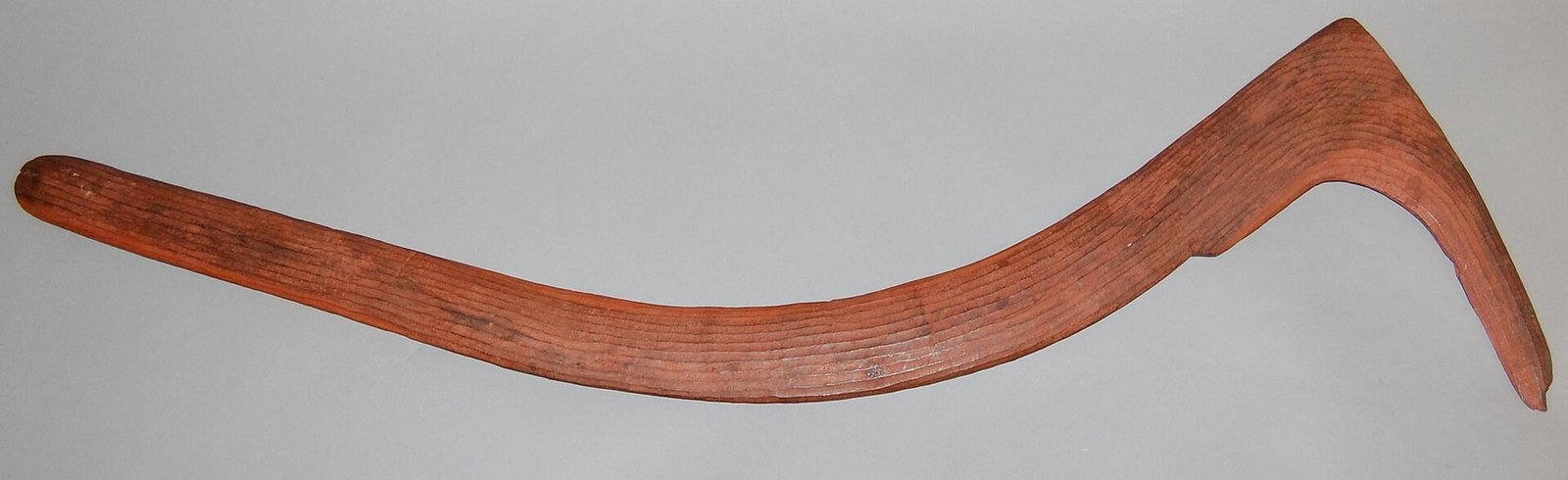
Hooked boomerangs known as “number 7” forms are thought to have been produced around the Tanami Desert. Inland trade routes carried them into Central and Northern Australia. Their distribution connects the history of a particular shape with exchange between places.
The Metropolitan Museum of Art holds a wooden example attributed, with uncertainty, to Warlpiri or Warumungu communities. It dates from the late nineteenth to early twentieth century and measures 25.7 by 71.8 centimetres. This object provides a specific example alongside the broader account of hooked forms and trade.
How old are boomerangs?
The National Museum of Australia dates the boomerangs discovered at Wyrie Swamp in South Australia to about 10,000 years ago. They were found in 1973. The age of the objects and the date of discovery are separate parts of their archaeological history.
A mammoth-ivory boomerang from Obłazowa Cave in Poland extends the discussion beyond Australia. Experimental investigations showed that it could fly as a non-returning boomerang. Its material differs from the traditional Australian hardwood examples described here, while its flight belongs to the non-returning category.
Its proposed age has changed. An Australian Museum page from 2023 describes the Polish object as approximately 23,000 years old. A 2025 study by Talamo and colleagues places it much earlier, using a model of its archaeological context rather than a direct measurement of the boomerang itself.
That study proposes a range of 42,290–39,280 cal BP with 95.4 percent probability. When you compare the two age claims, the method matters: the newer range comes from modelling the context surrounding the object.
Timeline
- 42,290–39,280 cal BP: The range proposed for the Obłazowa boomerang by the 2025 study.
- About 10,000 years ago: The period assigned by the National Museum of Australia to the Wyrie Swamp boomerangs.
- 1520–1795: The date range assigned by carbon dating to the Hillsdale boomerang.
- 1838: The first correct explanation of boomerang flight appeared anonymously in Dublin University Magazine, according to the Australian Museum.
- 1931: The Hillsdale boomerang was discovered during sewer works in Sydney.
- 1973: The ancient wooden boomerangs at Wyrie Swamp were found.
- 1975: Dutch scientist Felix Hess published Boomerang, Aerodynamics and Motion.
- 2025: Talamo and colleagues reassessed the age of the Obłazowa boomerang.
Details you won’t find in guidebooks
The Hillsdale boomerang was found about 10.5 metres below ground during sewer works in Sydney in 1931. Carbon dating carried out in 2019 dated it to between 1520 and 1795. The discovery depth, discovery year and date range each describe a different part of this object’s history.
The history of explaining boomerang flight has its own interruption. According to the Australian Museum, the first correct explanation appeared without an author’s name in Dublin University Magazine in 1838. It was then forgotten for more than a century. Felix Hess later examined boomerang movement in his 1975 work.
The duck-hunting method also rewards closer attention. The returning boomerang imitated a gliding predator while prepared nets completed the arrangement. Together with heavy fish-killing implements and large combat clubs, this use shows the range of activities associated with boomerangs in Aboriginal communities.
FAQ
Do all boomerangs return?
No. According to the National Museum of Australia, most Aboriginal boomerangs are non-returning types.
Why does a returning boomerang come back?
Its wing-shaped arms generate unequal lift as it spins and moves forward. The resulting torque changes its spinning axis through gyroscopic precession, curving its flight.
How old are boomerangs in Australia?
The National Museum of Australia dates the boomerangs found at Wyrie Swamp in South Australia in 1973 to about 10,000 years ago.
What did Aboriginal communities use boomerangs for?
Uses included hunting, close combat, percussion in music and dance, and ceremonies. Boomerangs also appear in creation narratives.
Sources
- Powerhouse Collection — Boomerang collection.powerhouse.com.au
- National Museum of Australia — Earliest evidence of the boomerang in Australia nma.gov.au
- Australian Museum — Boomerangs australian.museum
- Australian Museum — The returning Boomerang: how it flies australian.museum
- Australian Museum — Why a Boomerang flies australian.museum
- PLOS ONE — Boomerang and bones journals.plos.org
- The Metropolitan Museum of Art — Boomerang metmuseum.org
Image: "Number 7" fighting boomerang.jpg — The Trustees of the British Museum, CC BY-SA 4.0