Who was Tariq ibn Ziyad?
Tariq ibn Ziyad was the Umayyad commander who began the Muslim conquest of the Iberian Peninsula in 711. His opponent was the Visigothic Kingdom. He served under Musa ibn Nusayr, governor of North Africa. Both men answered to Caliph al-Walid I, who reigned from 705 to 715.
The TDV Islamic Encyclopedia dates his birth to about 670. That date has a small consequence. The Prophet Muhammad died in 632. A man born around 670 therefore cannot have been one of the Companions.
You may know his name from Gibraltar, which sits at the narrow strait he crossed. The rest of his life is far less certain than that famous name suggests.
Did Tariq ibn Ziyad really burn the ships?
This is the question most people ask. The short answer is that the evidence is weak.
The story goes like this. Tariq’s soldiers landed on the Spanish coast in 711. He burned the ships behind them. With no way home, they had to fight.
The purpose of the story is clear. It cuts off any hope of retreat. But the sources tell a different tale.
- Turkish Wikipedia presents the burning as a real event.
- English Wikipedia calls it a legend recorded more than four centuries after 711.
- İsmail Hakkı Atçeken, in a 2002 study, traces the first record to al-Idrisi, a 12th-century geographer.
- Atçeken also notes that early historians never mention it. He names Ibn Abd al-Hakam, al-Baladhuri, al-Tabari and Ibn al-Qutiyya.
Silence from four early writers counts as evidence. Atçeken treats it as an argument against the story.
He does not close every door. He finds the burning of all the ships unacceptable. But he leaves open one narrow possibility. One or two ships may have been burned as a symbol. That cannot be proven.
Think of a quote that spreads online today. Everyone repeats it, and nobody can name the first person who said it. The ship story works the same way. It is memorable, so it survived.
Whose ships were they?
Even the ships are debated. One view says Julian supplied four merchant vessels. Another says Muslim fleet ships were built in Tunisia. Atçeken thinks both groups were used together.
The famous speech
A speech is also attributed to Tariq. In the version quoted on Turkish Wikipedia, he tells his men that the sea is behind them like an enemy and the enemy ahead is like a sea.
Its authenticity is disputed. Omayra Herrero Soto’s 2010 study examines the different versions of the text across the centuries. She also looks at the rhetorical patterns it shares with other battle speeches. So the words may reflect later storytelling more than a recorded address.
Tariq ibn Ziyad: nationality, origin and ethnicity
These three searches ask almost the same thing. No single answer exists.
Many modern researchers regard Tariq as Berber. Medieval Arab historians, however, give contradictory accounts of his origin. The TDV lists Berber, Iranian and Arab views. A Turkish origin is not among them.
A 2022 article in Al-Qanṭara by Jesús Lorenzo-Jiménez rejects the North African Berber origin. It looks for his roots in the Sasanian world instead.
“Nationality” is a modern idea. In 711 there was no such label to attach to him. What we can say is that he was an Umayyad commander serving Musa ibn Nusayr.
Where was Tariq ibn Ziyad born?
Nobody knows for sure. English Wikipedia cites a tradition from David Nicolle. It places his birth in the Tafna valley near Tlemcen, in present-day Algeria.
That is a tradition, not a record. The only firm anchor is the approximate date of 670 from the TDV.
Was Tariq ibn Ziyad Black?
This question comes up often. The sources do not settle it.
A research article in Cambridge’s Church History discusses a later account of the conquest. It dates to the 12th century or after. That account mentions soldiers called al-Sudan in Tariq’s army. But the record does not describe Tariq’s own skin colour.
Before the crossing
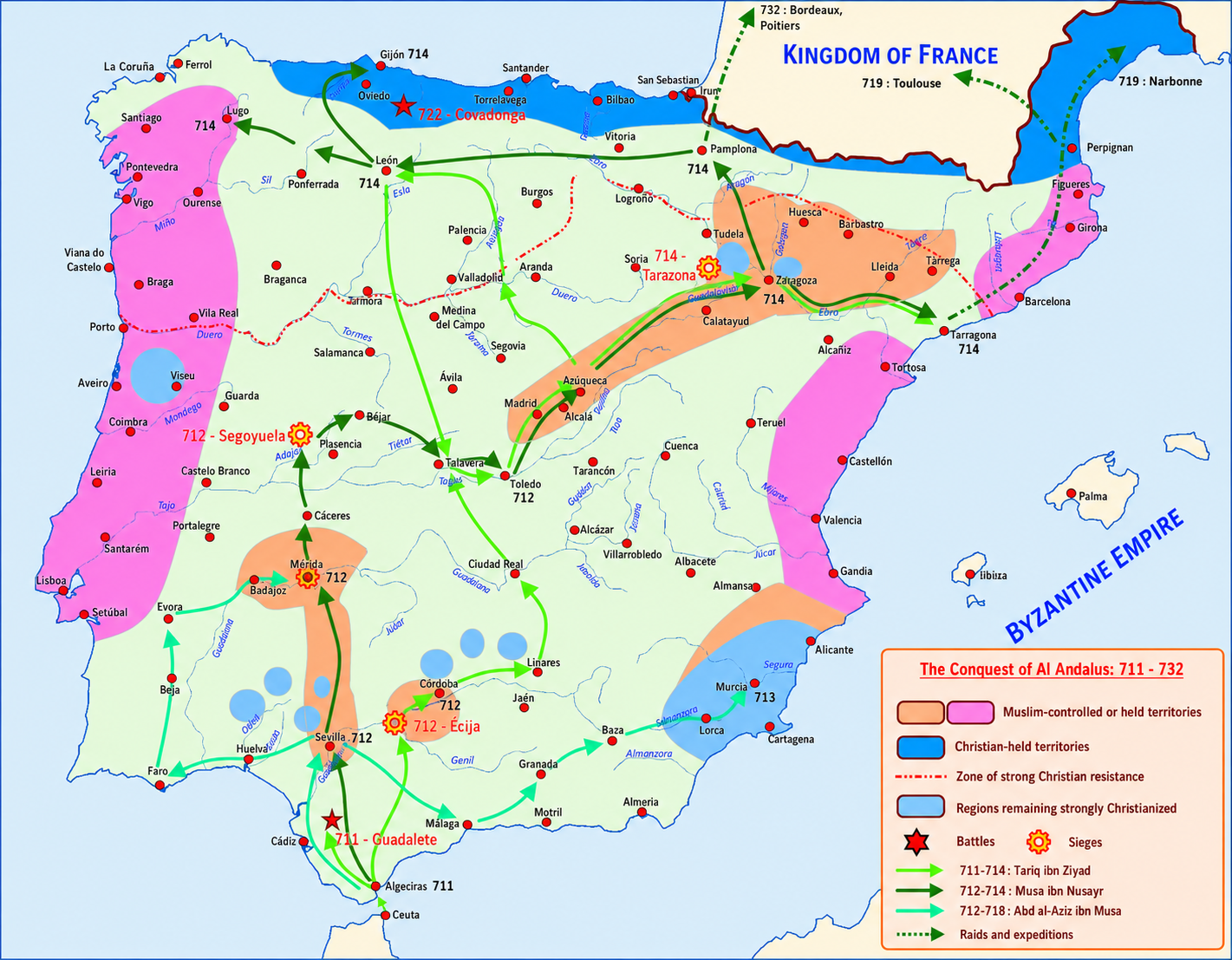
Musa ibn Nusayr appointed Tariq governor of Tangier in 708, according to the TDV. Then came a scouting trip. In 710, Tarif ibn Malik crossed to southern Spain with a force of 500 men.
That raid was small.
The landing at Gibraltar
Traditional accounts say Tariq’s army numbered about 7,000 men in 711. Most were Berber. The TDV dates his camp at Gibraltar to 28 April 711.
The mountain took his name. Gibraltar comes from the Arabic Jabal Tariq, meaning Tariq’s mountain. If you ever stand on the Rock, you are standing on that name.
Musa later sent 5,000 more men, according to the TDV. That raised Tariq’s force to about 12,000.
The Battle of Guadalete
The Visigothic king was Roderic. One tradition says he gathered 100,000 men. Roger Collins, as cited by English Wikipedia, suggests the real number may have been much lower.
The date of the victory at Guadalete in July 711 also varies. English Wikipedia gives 19 July. The TDV describes an eight-day battle and gives 26 July as its end.
After the victory, Tariq split his army. The unit of Mughith al-Rumi took Córdoba. Tariq himself advanced on Toledo, the Visigothic capital.
Timeline
- About 670: Birth of Tariq, according to the TDV.
- 708: Appointed governor of Tangier, according to the TDV.
- 710: Tarif ibn Malik’s scouting raid on southern Spain.
- April 711: Tariq makes camp at Gibraltar (28 April, according to the TDV).
- July 711: The Visigothic army is defeated at Guadalete.
- After Guadalete: Tariq’s army splits, one unit taking Córdoba while Tariq advances on Toledo.
- 714: Tariq and Musa are summoned to Damascus.
- About 720: Death of Tariq, according to English Wikipedia and the TDV.
- 12th century: Al-Idrisi gives the first record of the ship burning, according to Atçeken.
Musa and Tariq: rivals?
Some stories describe jealousy between the two men. The 9th-century historian al-Baladhuri tells a calmer story. He mentions only a harsh letter, followed by a reconciliation.
Caliph al-Walid I called both men to Damascus in 714.
What happened to Tariq?
His end is as uncertain as his beginning. English Wikipedia gives his death as about 720 in Damascus. The TDV also gives 720. But it says nothing is known about his later life, and it names no grave.
Details you won’t find in guidebooks
- The 2022 Al-Qanṭara study argues that the bond of wala’ between Tariq and Musa may go back to long before Musa arrived in North Africa. If so, they knew each other earlier than the conquest story suggests.
- Tarif ibn Malik’s 500-man raid in 710 came a year before Tariq’s crossing. The better-known 7,000 men were not the first Muslim soldiers to see southern Spain.
- The al-Sudan soldiers appear in a late account. They do not tell us what Tariq looked like.
- The ship-burning story has no support in four early historians. Its first known record comes from a geographer, not a chronicler of the conquest.
- The Rock of Gibraltar keeps his name in daily use. The place where he is buried is not recorded.
FAQ
Did Tariq ibn Ziyad burn his ships?
Probably not as the legend tells it. English Wikipedia calls the story a legend recorded more than four centuries after the event. İsmail Hakkı Atçeken finds burning all the ships unacceptable. He leaves open only a symbolic burning of one or two vessels, which remains unproven.
Where was Tariq ibn Ziyad born?
No one can say for certain. One tradition, cited by English Wikipedia from David Nicolle, places his birth in the Tafna valley near Tlemcen in present-day Algeria. The TDV Encyclopedia dates his birth to about 670.
What was Tariq ibn Ziyad’s ethnicity?
Many modern researchers consider him Berber. Medieval Arab historians give conflicting information, and a 2022 article by Jesús Lorenzo-Jiménez looks for his origin in the Sasanian world instead. A Turkish origin is not among the views the TDV lists.
Where did Tariq ibn Ziyad die?
English Wikipedia gives about 720 in Damascus. The TDV also gives 720 but says nothing is known of his later life and names no burial place.
Sources
- English Wikipedia — Tariq ibn Ziyad en.wikipedia.org
- Türkçe Vikipedi — Tarık bin Ziyad tr.wikipedia.org
- TDV İslâm Ansiklopedisi — Târık b. Ziyâd islamansiklopedisi.org.tr
- İsmail Hakkı Atçeken — Târık b. Ziyâd Endülüs’ün Fethi Öncesinde Gemileri Yaktı mı? isamveri.org
- Al-Qanṭara / CSIC — Los orígenes de Mūsà ibn Nuṣayr y Ṭāriq ibn Ziyād y su relación con el imperio sasánida al-qantara.revistas.csic.es
- Talia Dixit / EBSCO — La arenga de Tariq b. Ziyad openurl.ebsco.com
- Cambridge University Press — Naming North Africans in Latin Christian Chronicles from Medieval Iberia cambridge.org
Image: Muslim conquest of the Iberian Peninsula 711-719.png — Elryck, NACLE, CC BY-SA 4.0