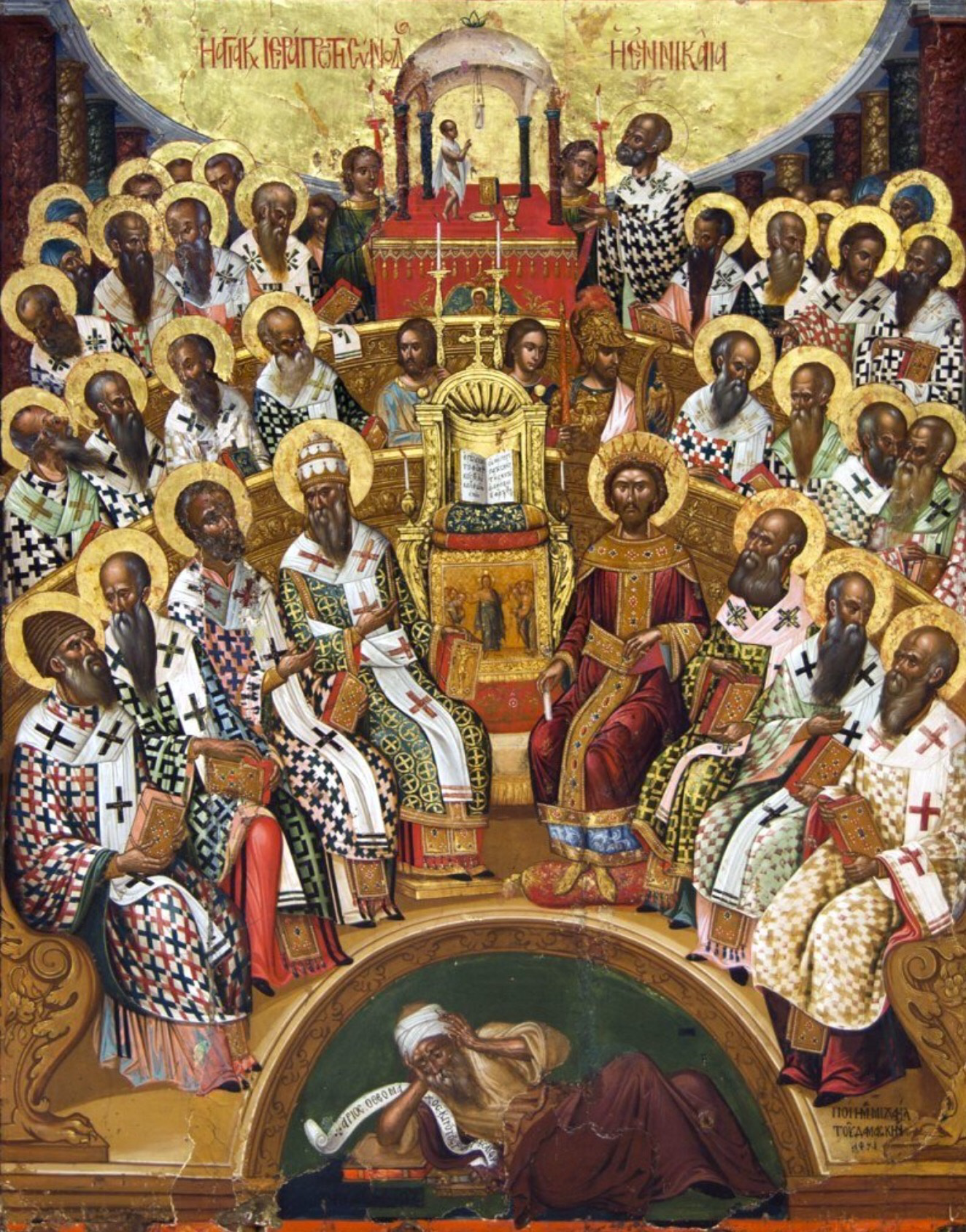
What is the First Council of Nicaea (325 AD)?
The First Council of Nicaea was the first ecumenical Christian council. Roman Emperor Constantine I called it, and it met in 325 CE. “Ecumenical” means the invitation went to bishops across the empire, not to one region.
The town where it met is still there. Ancient Nikaia is today’s İznik, in Bursa Province, on the shore of İznik Lake. If you search for the “First Council of Nicaea in 325 C.E.”, this is the event you want.
Where was the First Council of Nicaea held?
The location is İznik, Türkiye. UNESCO’s tentative list entry for the town confirms that ancient Nikaia and modern İznik are the same place.
The exact building is less certain. Two ideas compete.
- A lakeside palace. Charles Odahl argues that the sessions the emperor attended took place in a palace on the lake shore.
- A church under the water. The ruins of a basilica in İznik Lake were discovered in 2014. In 2026, excavation head Mustafa Şahin proposed that an older church floor about 30 centimetres below the big basilica could belong to one of the council’s meeting places.
Other experts disagree. Young Richard Kim notes that the dating of the older church is not settled. Treat the link between the underwater ruins and the council as a hypothesis, not a fact.
The 2014 date is the year the ruins were found. It is not the date of the council.
When did the First Council of Nicaea start?
The year is 325. The day is debated. The fifth-century historian Socrates gives 20 May 325. Modern assessments also allow for an opening in June.
So you will see both dates in books. Neither changes the year.
What happened at the First Council of Nicaea?
The bishops did not arrive at random. Constantine’s treasury paid their travel costs. That is one detail guidebooks tend to skip.
Most of the bishops came from the eastern provinces, and more than 100 came from Anatolia. The traditional headcount is 318. Contemporary reports say 250 to 300.
Constantine gave his opening speech in Latin, even though most participants spoke Greek.
The council then worked through three matters, covered in the next section. It produced a creed, 20 canons and a letter to the Church of Alexandria.
What was the purpose of the First Council of Nicaea?
The Cambridge History of Christianity names three main items.
- The dispute raised by the teaching of Arius.
- A common date for Easter.
- The Meletian split in Egypt.
The dispute over Arius
Arius was a presbyter in Alexandria. He argued that only the Father is eternal and that the Son had a beginning. His bishop, Alexander, taught that the Son was born of the Father eternally. The quarrel started in Alexandria.
The council answered with a creed. It called Jesus Christ homoousios, a Greek word meaning “of the same substance” as the Father. It stated that the Son was begotten, not created. That rejected the central claim of the Arian view.
The text ends with anathemas, or condemnations. They targeted anyone who said the Son once did not exist, or that he could change.
Arius did not accept the creed. He was excommunicated and exiled to Illyria, along with Theonas and Secundus.
One date for Easter
This is the part that touches your calendar. When you check the date of Easter each spring, you are living with a decision the church wanted settled in 325.
The council’s letter to Alexandria says that eastern communities that had kept Easter by the Jewish calendar would now celebrate at the same time as Rome and Alexandria.
The principles stated in 325 were a common celebration and a calculation independent of the Jewish calendar. The detailed calculation methods came in later centuries.
The Meletian split
In Egypt, the followers of Meletius had split from the church. The council let Meletius keep his title of bishop. It removed his authority to appoint new clergy.
First Council of Nicaea documents (and PDF)
Three documents survive from the council.
- The original Nicene Creed.
- Twenty canons, which are rules for church life.
- The letter sent to the Church of Alexandria.
You can read English translations online at New Advent, listed in the sources below. That page is the easiest place to find the text for reading or printing as a PDF.
The Wikipedia article on the council is a useful overview. For the primary texts, go to the translations.
What the council did not do
A popular claim says the council picked the four Gospels or the 27 books of the New Testament. The TDV Islamic Encyclopedia notes that this is not confirmed by early council records or by the related Christian sources. The creed, the canons and the letter are the council’s actual output.
The council also did not end the argument. Arianism continued, and debates inside the church ran through the fourth century.
In 381, the First Council of Constantinople changed the 325 creed. It became the later Nicene-Constantinopolitan creed.
First Council of Nicaea church: which İznik building is which?
The town holds more than one council story. İznik’s Hagia Sophia hosted the Second Council of Nicaea in 787. Do not mix it up with the council of 325.
So when you stand in İznik, ask which council a sign refers to. The year on it answers the question.
Timeline
- 325: Constantine calls the First Council of Nicaea. The creed and 20 canons are adopted.
- 20 May 325: the opening date given by the historian Socrates. Other assessments differ on the exact day.
- 381: the First Council of Constantinople develops the Nicene creed.
- 787: the Second Council of Nicaea meets in İznik’s Hagia Sophia.
- 2014: basilica ruins are discovered in İznik Lake.
- 28 November 2025: Pope Leo XIV and Ecumenical Patriarch Bartholomew I join a prayer at İznik for the 1,700th anniversary.
- 2026: a link between an older church floor under the basilica and the council is proposed. Independent experts say the identification is not settled.
Details you won’t find in guidebooks
- Travel was paid for. The imperial treasury covered the bishops’ journey costs.
- The opening speech was in Latin. Most participants spoke Greek.
- Canon 4 set a minimum. If all bishops of a province could not gather to appoint a bishop, at least three had to be present. The others had to give written approval.
- Canon 17 banned lending at interest. Clergy who lent money at interest were to be removed from the clergy.
- Canon 20 dealt with posture. On Sundays and in the period from Easter to Pentecost, prayers were to be said standing, not kneeling.
The 1,700th anniversary
2025 marked 1,700 years since the council. On 28 November 2025, Pope Leo XIV and Ecumenical Patriarch Bartholomew I took part in a joint prayer on the shore of İznik Lake.
This was a commemoration. It was not a new council.
FAQ
Where was the First Council of Nicaea held?
It met in ancient Nikaia, which is today İznik, a town in Bursa Province, Türkiye. Archaeologists still debate which building hosted the sessions.
What was the purpose of the First Council of Nicaea?
It had three main items: the dispute over the teaching of Arius, a common date for Easter, and the Meletian split in Egypt.
Did the Council of Nicaea choose the books of the Bible?
No. The claim that the four Gospels or the 27 books of the New Testament were chosen there is not confirmed by early council records or by the related Christian sources.
How many bishops attended?
Tradition says 318. Contemporary attendance reports give a range of 250 to 300. More than 100 came from Anatolia.
Is the 325 creed the same as the creed recited today?
Not exactly. The First Council of Constantinople in 381 changed the 325 text, and it developed into the later Nicene-Constantinopolitan creed.
Sources
- TDV Islamic Encyclopedia, “İznik Konsili” islamansiklopedisi.org.tr
- UNESCO World Heritage Centre, İznik (tentative list) whc.unesco.org
- English Wikipedia, “First Council of Nicaea” en.wikipedia.org
- Cambridge History of Christianity, “The first Council of Nicaea” cambridge.org
- New Advent, “First Council of Nicæa” (creed, canons, synodal letter) newadvent.org
- Turkish Wikipedia, “Birinci İznik Konsili” tr.wikipedia.org
- Live Science, First Council of Nicaea location debate livescience.com
Image: First Council of Nicaea Michael Damaskinos.png — Michael Damaskinos, Public domain