You may have seen the claim that Aboriginal Australians are the world’s oldest living culture. It is a powerful line. It is also a little too simple. This article sets out what the evidence says about their origins, their languages and art, and what British colonisation cost them.
Aboriginal Australians: meaning of the name
“Aboriginal Australians” covers the Indigenous peoples of the Australian mainland and many of its islands. Torres Strait Islanders are culturally and ethnically distinct, so they are counted separately. The word “Aboriginal” comes from the Latin words ab and origine. In Turkish, the topic appears as “Avustralya Aborjinleri” or “Avustralya yerlileri”.
There is no single Aboriginal culture. Historically, Aboriginal peoples formed about 500 linguistic and regional groups. So “one of the world’s oldest continuous cultures” is a more accurate phrase than “the oldest living culture”.
Where did Aboriginal Australians come from?
The best-known answer comes from Madjedbebe. It is a sandstone rock shelter in Arnhem Land, in Australia’s Northern Territory. It lies on the traditional land of the Mirarr people. It was formerly known as Malakunanja II.
In 2017, Chris Clarkson and colleagues published a paper in Nature. They argued that people lived at the site about 65,000 years ago. That is the source of the “65,000 years” figure.
The date is contested. In 2018, James O’Connell and colleagues argued that the Madjedbebe tools may have moved down into older sand layers after they were made. They supported a chronology of about 50,000 years for the settlement of Sahul, the landmass of Australia and New Guinea.
A 2025 study in Science Advances pointed the other way. It analysed 2,456 mitochondrial genomes. It proposed that Sahul was settled about 60,000 years ago, by at least two separate routes.
So the honest summary is this. The settlement is very old. The exact start date is still argued over by researchers.
Timeline
- About 65,000 years ago: the start of human occupation at Madjedbebe, as proposed by the 2017 excavation paper. Academic debate continues.
- At least 6,600 years ago: the documented history of the Gunditjmara aquaculture system at Budj Bim.
- 26 January 1788: Arthur Phillip founds a British convict settlement at Sydney Cove.
- April 1789: a smallpox epidemic devastates Indigenous communities around Sydney.
- 1910–1970: the period in which the Bringing Them Home report estimated that Indigenous children were forcibly removed.
- 1962: Aboriginal and Torres Strait Islander people gain the right to vote in federal elections.
- 27 May 1967: 90.77 per cent of voters back the constitutional changes concerning Aboriginal people.
- 1971: the Aboriginal flag is first used, and the Papunya painting movement begins.
- 1972: the Papunya Tula Artists cooperative is founded.
- 3 June 1992: the Mabo decision recognises native title.
- 1997: the Bringing Them Home report is published.
- 13 February 2008: Prime Minister Kevin Rudd apologises to the Stolen Generations.
- 2017: the roughly 65,000-year date for Madjedbebe is published in Nature.
- 2025: a study of 2,456 mitochondrial genomes supports settlement of Sahul about 60,000 years ago.
Aboriginal Australians history: the cost of colonisation
On 26 January 1788, the British under Arthur Phillip set up a convict settlement at Sydney Cove. Disease came next. About 15 months after the First Fleet arrived, in April 1789, a smallpox epidemic began. It hit Indigenous communities around Sydney hard.
Violence followed. The University of Newcastle’s database of colonial frontier massacres records 10,374 people killed in massacres of Aboriginal and Torres Strait Islander people by colonisers. The database describes this as a conservative minimum estimate.
Aboriginal people did not simply give way. Henry Reynolds’s book The Other Side of the Frontier, first published in 1981 by James Cook University, examines Aboriginal resistance to British settlement and invasion from 1788 onward.
Then came the removal of children. The 1997 Bringing Them Home report estimated that between one in ten and one in three Indigenous children were forcibly taken from their families and communities between 1910 and 1970. On 13 February 2008, Prime Minister Kevin Rudd formally apologised to Aboriginal and Torres Strait Islander peoples. He addressed the Stolen Generations in particular. The apology covered forced child removal and assimilation policies.
Aboriginal Australians language
Before British colonisation, more than 250 Indigenous languages and about 800 dialects were spoken in Australia. Colonisation broke that web of languages.
The Third National Indigenous Languages Survey (2018–2019) found 123 Indigenous languages still spoken. Of these, 109 were endangered.
Aboriginal Australians art
Aboriginal art has deep roots. One modern chapter is easy to date. In 1971, Aboriginal artists at Papunya began transferring traditional designs onto small boards using acrylic paint. In 1972, they founded the Papunya Tula Artists cooperative.
If you have ever stood in front of a dot painting in a gallery, this is the movement behind it. The paint is modern. The designs come from tradition.
Aboriginal Australians flag
The Aboriginal flag was designed by Harold Thomas, a Luritja artist. It was first used in 1971. In 1995, it was recognised as one of Australia’s official flags.
The colours carry meaning. Black represents Aboriginal people. Red represents the earth. The yellow circle in the centre represents the sun.
Aboriginal Australians population and where they live
In the 2021 census, 742,882 people said they were Aboriginal only. Another 33,765 said they were Torres Strait Islander only. A further 36,083 said they were of both origins.
Most do not live in the remote outback. In 2021, 85 per cent of Aboriginal and Torres Strait Islander people lived in cities and regional areas. Only 15 per cent lived in remote areas.
Aboriginal Australians today
Official figures show a large gap. For 2020–2022, life expectancy at birth for Aboriginal and Torres Strait Islander people was 71.9 years for men and 75.6 years for women. That was 8.8 years lower for men and 8.1 years lower for women than for non-Indigenous Australians.
Legal change has also come, slowly. The Mabo decision of 3 June 1992 recognised the traditional land rights of the Meriam people of the Torres Strait. It accepted that native title exists in Australian law. It also overturned the idea of terra nullius, the claim that the land belonged to no one.
Are Aboriginal Australians black? What about blonde hair?
Skin colour is not a test of identity. The University of Technology Sydney explains that members of the same Aboriginal family can have different skin colours. Aboriginal identity cannot be decided by skin colour.
Fair hair has also been studied. In 1953, A. A. Abbie and W. R. Adey published a pigmentation study in the American Journal of Physical Anthropology. Its special subject was fair-headedness in a central Australian Indigenous community.
Aboriginal Australians and IQ
Be careful with this one. In 1981, Judith Kearins studied Aboriginal children aged 6 to 17 from desert regions. On certain visual-spatial memory tasks, they performed better than white Australian children. That result says nothing about a people’s overall IQ.
Details you won’t find in guidebooks
- A toolkit at Madjedbebe. The finds dated to about 65,000 years ago in the 2017 paper include grindstones, worked ochre, reflective additives and axe heads with ground edges.
- Eel farming at Budj Bim. In Victoria, the Gunditjmara built channels, weirs and dams from volcanic stone for at least 6,600 years. They used the system to trap and store short-finned eels.
- Painting rules at Papunya. After community objections to private cultural knowledge appearing in the first paintings, the artists changed their style. They began to hide secret or sacred information.
- The 1967 myth. Many people say the 1967 referendum gave Aboriginal people the vote. It did not. Voting rights in federal elections became law in 1962. The 1967 referendum removed the constitutional exclusion from the census count. It also widened the federal parliament’s power to make laws about Aboriginal people.
FAQ
Are Aboriginal Australians the world’s oldest living culture?
Not as a single culture. Aboriginal peoples historically formed about 500 linguistic and regional groups. It is more accurate to speak of some of the world’s oldest continuous cultures. The 65,000-year figure comes from the Madjedbebe excavation and is still debated.
How many Aboriginal Australians are there?
In the 2021 census, 742,882 people identified as Aboriginal only, 33,765 as Torres Strait Islander only, and 36,083 as both.
Where do Aboriginal Australians live?
In 2021, 85 per cent of Aboriginal and Torres Strait Islander people lived in cities and regional areas. 15 per cent lived in remote areas.
Sources
- Türkçe Vikipedi — Avustralya Aborjinleri tr.wikipedia.org
- Wikipedia — Aboriginal Australians en.wikipedia.org
- Nature — Human occupation of northern Australia by 65,000 years ago nature.com
- PNAS — When did Homo sapiens first reach Southeast Asia and Sahul? pmc.ncbi.nlm.nih.gov
- Science Advances — Genomic evidence supports the long chronology for the peopling of Sahul pmc.ncbi.nlm.nih.gov
- Wikipedia — Madjedbebe en.wikipedia.org
- UNESCO — Budj Bim Cultural Landscape whc.unesco.org
- National Archives of Australia — Dispossession and revival of Indigenous languages naa.gov.au
- National Museum of Australia — Papunya Tula nma.gov.au
- National Museum of Australia — Flags nma.gov.au
- National Museum of Australia — Convict cargo nma.gov.au
- National Museum of Australia — Smallpox epidemic nma.gov.au
- University of Newcastle — Colonial Frontier Massacres Statistics c21ch.newcastle.edu.au
- Australian Human Rights Commission — Bringing Them Home Community Guide humanrights.gov.au
- National Museum of Australia — National Apology nma.gov.au
- National Archives of Australia — The 1967 Referendum naa.gov.au
- National Museum of Australia — Mabo decision nma.gov.au
- Australian Bureau of Statistics — 2021 Census QuickStats abs.gov.au
- Australian Institute of Health and Welfare — First Nations people aihw.gov.au
- Australian Bureau of Statistics — Aboriginal and Torres Strait Islander life expectancy abs.gov.au
- University of Technology Sydney — Heterogeneity of Indigenous Australians uts.edu.au
- PubMed — Pigmentation in a central Australian tribe with special reference to fair-headedness pubmed.ncbi.nlm.nih.gov
- Cognitive Psychology — Visual spatial memory in Australian Aboriginal children of desert regions doi.org
- Wikipedia — The Other Side of the Frontier en.wikipedia.org
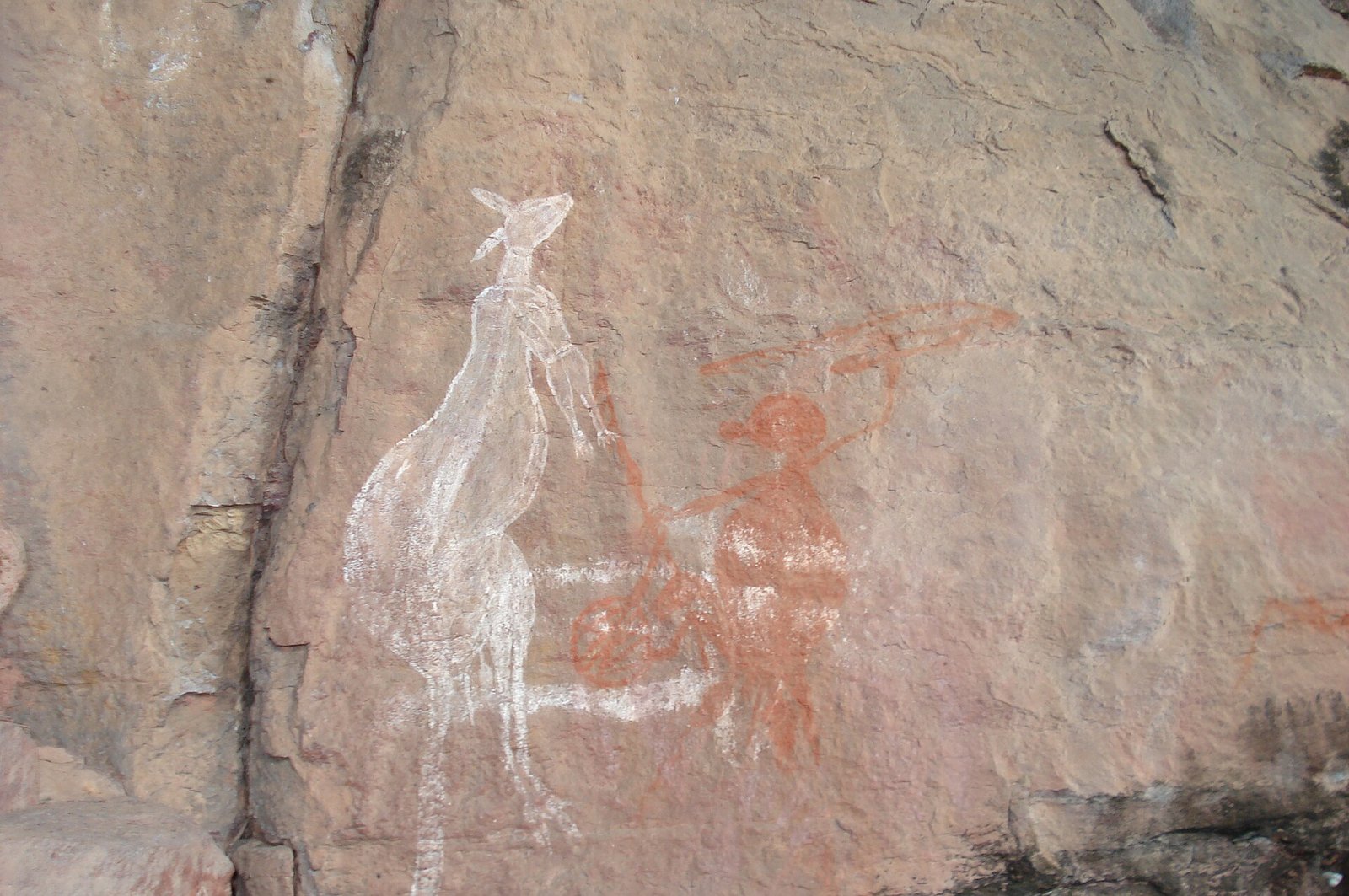
Image: Aboriginal rock art, Nourlangie Rock, Kakadu – panoramio.jpg — AwOiSoAk KaOsIoWa, CC BY-SA 3.0