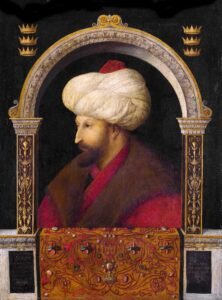
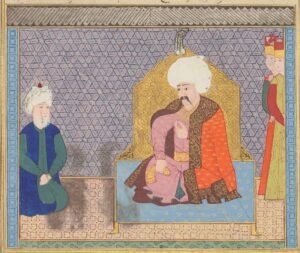
If you walk through Istanbul’s old city today, you can order a coffee almost anywhere. In 1633 that was a risky thing to run a business around. Sultan Murad IV had just ordered coffeehouses closed. He also backed a tobacco ban with the death penalty. This article separates what the sources confirm from what later storytellers added.
Murad IV: who was this sultan?
Murad IV was born on 27 July 1612 in Topkapı Palace, Istanbul. His father was Sultan Ahmed I. His mother was Kösem Sultan.
He became the 17th Ottoman sultan on 10 September 1623. He replaced his uncle Mustafa I. He was 11 years old.
A child could not rule alone. For 1623–1632, the regency of his mother Kösem Sultan shaped how the state was run.
In May 1632 that changed. After he removed Grand Vizier Topal Receb Pasha, Murad took the government into his own hands. The rest of his reign, about eight years, is the one people remember.
Murad IV and coffee: what happened in 1633?
The key document is an order dated 2 September 1633, which the scholar İdris Bostan reports. It told officials to close coffeehouses in Istanbul first, then in other Ottoman cities.
Two religious voices pushed the decision. One was the preacher Kadızâde Mehmed Efendi. The other was Şeyhülislâm Ahîzâde Hüseyin Efendi, who issued a fatwa against coffee and tobacco.
The order was carried out on the ground. In Eyüp, Topçular, Yedikule, Alibeyköy and nearby areas, 120 coffee shops were shut and their hearths torn down. That detail comes from Fatma Gül Karagöz’s 2020 article.
The record also names who did the paperwork. The Eyüp judge Müftizâde İsmail Fahreddin and the chief sapper Mir Abdülkerim drew up the list of shops and their keepers.
Note the wording, though. Karagöz’s archive study says the coffeehouses were closed, but coffee trade was not banned outright the way tobacco trade was. “Murad banned coffee” is a simplification.
Why did he go after tobacco?
A popular story links the ban to a fire in the Cibali district in 1633. The story says smoking in coffeehouses started it. That cause is disputed. The TDV entry on Murad blames the fire on a ship caulker instead.
What is not disputed is the penalty. According to the chronicler Naîmâ, the tobacco ban in Murad’s time prescribed siyaseten katl, execution as a state penalty, for people who kept smoking.
The ban was harsher than the coffeehouse closures. One targeted a place. The other targeted a habit, and threatened a person’s life.
Was Murad IV cruel?
Historians do not agree. Here is what is on record.
- On 7 January 1634 he had Şeyhülislâm Ahîzâde Hüseyin Efendi strangled. He was the first Ottoman sultan to have a chief religious authority killed. This was the same man whose fatwa had backed the coffee and tobacco ban.
- During his campaigns of 1635 and 1638, his brothers Bayezid, Süleyman and Kasım were executed. This reduced the number of male members of the dynasty.
- Critics such as Kâtib Çelebi and Solakzâde condemned the harsh enforcement.
- Naîmâ explained it differently. In his account, the severity aimed at suppressing tyrants and bandits.
So “iron-fisted” is fair as a description of method. Whether it was justified is a question the old chroniclers themselves argued over.
Murad IV as a soldier: Baghdad, 1638
Murad did not only rule from the palace. He led the 1638 Baghdad campaign in person. The city had been in Safavid hands since 1624. The campaign returned it to Ottoman rule.
Baghdad surrendered on 24 December 1638. The war with the Safavids ended with the Treaty of Kasr-ı Şirin, signed on 17 May 1639.
This is the achievement that earns him respect even from people who dislike his methods.
Murad IV’s height and his mace
How tall was he? No one can give you a number. Börekçi calls him tall and extraordinarily strong, but gives no measurement in centimeters.
The mace stories are bigger. The TDV entry repeats contemporary accounts that he wielded a mace of 200 okka. Turkish Wikipedia (Vikipedi) tells of a 60-kilogram mace. The two figures contradict each other. Neither should be treated as a verified measurement of a real object. The safe reading is that his strength became legend.
Murad IV’s wife and children
Of his consorts, only one is known with a clear name and title: Ayşe Sultan, a haseki, the sultan’s favored consort. Other names are not firmly established in the sources used here.
The number of children is also disputed. Evliya Çelebi reports 32. The TDV encyclopedia says about 16 can be identified, and five of them were sons.
Those five sons were Süleyman, Mehmed, Alâeddin, Ahmed and Mahmud. All died before their father. Börekçi confirms this but gives no cause of death for each child.
That is why the throne passed sideways. After Murad died, his younger brother Ibrahim became sultan in 1640.
How did Murad IV die? The cause of death
Murad died in Istanbul on 8 February 1640. He was 27.
The cause is debated. One claim is cirrhosis of the liver. English Wikipedia also cites sources that blame a long-running illness, gout. No single answer is settled, so be wary of any article that states one with certainty.
His body lies in Istanbul in the tomb of his father, Ahmed I, next to the Sultanahmet Mosque. If you visit the mosque, his grave is just beside it.
Timeline
- 27 July 1612 Born in Istanbul.
- 10 September 1623 Takes the throne in place of Mustafa I.
- May 1632 Takes direct control of the government.
- 1633 Coffeehouses are closed and the tobacco ban is hardened.
- 7 January 1634 Şeyhülislâm Ahîzâde Hüseyin Efendi is killed.
- 24 December 1638 Baghdad surrenders.
- 17 May 1639 Treaty of Kasr-ı Şirin is signed.
- 8 February 1640 Dies in Istanbul; his brother Ibrahim succeeds him.
Details you won’t find in guidebooks
- At his funeral, the three horses he rode on campaign were saddled backwards and led in front of his coffin.
- After the 1630 flood damaged the Kaaba, he had it repaired. The work was done through Judge Mehmed Efendi and the architect Rıdvan Ağa.
- He composed music. His pieces appear in Ali Ufkî Bey’s Mecmûa-i Sâz ü Söz and in Kantemiroğlu’s music book.
- His coffeehouse ban did not outlast the century’s middle. It was lifted in the first years of Mehmed IV’s reign, which began in 1648.
Murad IV on screen
If you want a dramatized version, Burak Sergen plays Murad IV in the film İstanbul Kanatlarımın Altında.
FAQ
Did Murad IV really ban coffee?
He ordered coffeehouses closed in 1633. Karagöz’s archive study says the coffee trade was not banned outright the way the tobacco trade was.
How did Murad IV die?
He died in Istanbul on 8 February 1640, aged 27. The cause is disputed: some accounts say cirrhosis, while sources cited by English Wikipedia point to long-running gout.
How many children did Murad IV have?
Sources disagree. Evliya Çelebi reports 32 children. The TDV encyclopedia says about 16 can be identified, five of them sons, who all died before their father.
Where is Murad IV buried?
In Istanbul, in the tomb of his father Ahmed I, next to the Sultanahmet Mosque.
Was Murad IV’s mace really 200 okka?
No source verifies it. The TDV entry gives 200 okka from contemporary accounts. Wikipedia gives 60 kilograms. Treat both as stories, not measurements.
Sources
- TDV İslâm Ansiklopedisi — Murad IV islamansiklopedisi.org.tr
- Fatma Gül Karagöz, “17. Yüzyılda Kahvehânelerin Kapatılması ve Tütün Yasaklarının Uygulanması,” 2020 dergipark.org.tr
- Günhan Börekçi, “Murad IV,” Encyclopedia of the Ottoman Empire (Ágoston and Masters) psi424.cankaya.edu.tr
- Wikipedia — Murad IV en.wikipedia.org
- Vikipedi — IV. Murad tr.wikipedia.org
Image: Murad IV.jpg — Wikimedia Commons, Public domain