The Behistun Inscription: a summary
The Behistun Inscription is a royal account carved into Mount Behistun in Iran for the Achaemenid ruler Darius I. It combines cuneiform texts with a rock relief. Its subject is power: how Darius claimed the throne, defeated his rivals, and explained his right to rule.
Its three languages also made it valuable to scholars trying to read cuneiform. Old Persian, Elamite, and Babylonian offered parallel accounts that could be compared. Yet Behistun did not unlock every script by itself. The decipherment involved other inscriptions, earlier discoveries, and several researchers.
Where is the Behistun Inscription?
Behistun lies about 30 kilometres east of Kermanshah in Iran. It stands on the historical route connecting Babylon with India. Its text names Lydia, Ionia, and Cappadocia among Darius’s possessions.
UNESCO describes the inscribed monument as approximately 15 metres high and 25 metres wide. It occupies a limestone cliff about 60 metres above the plain. Those measurements help explain why obtaining accurate copies became a demanding part of decipherment. Scholars needed to recover individual signs from a large surface high above the ground.
Bisotun entered the UNESCO World Heritage List in 2006. The listed property covers 187 hectares and was accepted under cultural criteria ii and iii. The protected site therefore extends beyond the dimensions of the inscribed relief itself.
What does the Behistun Inscription of Darius I say?
Darius presents himself as the ninth king of his dynasty. In sections I.4–5, he says that Ahuramazda gave him kingship. These statements establish the basis of his argument: his authority rests on both royal ancestry and divine support.
Section I.6 lists 23 countries under his rule. Lydia, Ionia, Cappadocia, and Egypt appear among them.
The account also explains the throne change at the centre of Darius’s accession. According to Darius, Gaumata impersonated Bardiya, the son of Cyrus, and seized power. Darius says that he overthrew this claimant. You need to keep that attribution in view: the inscription preserves Darius’s explanation of his own rise.
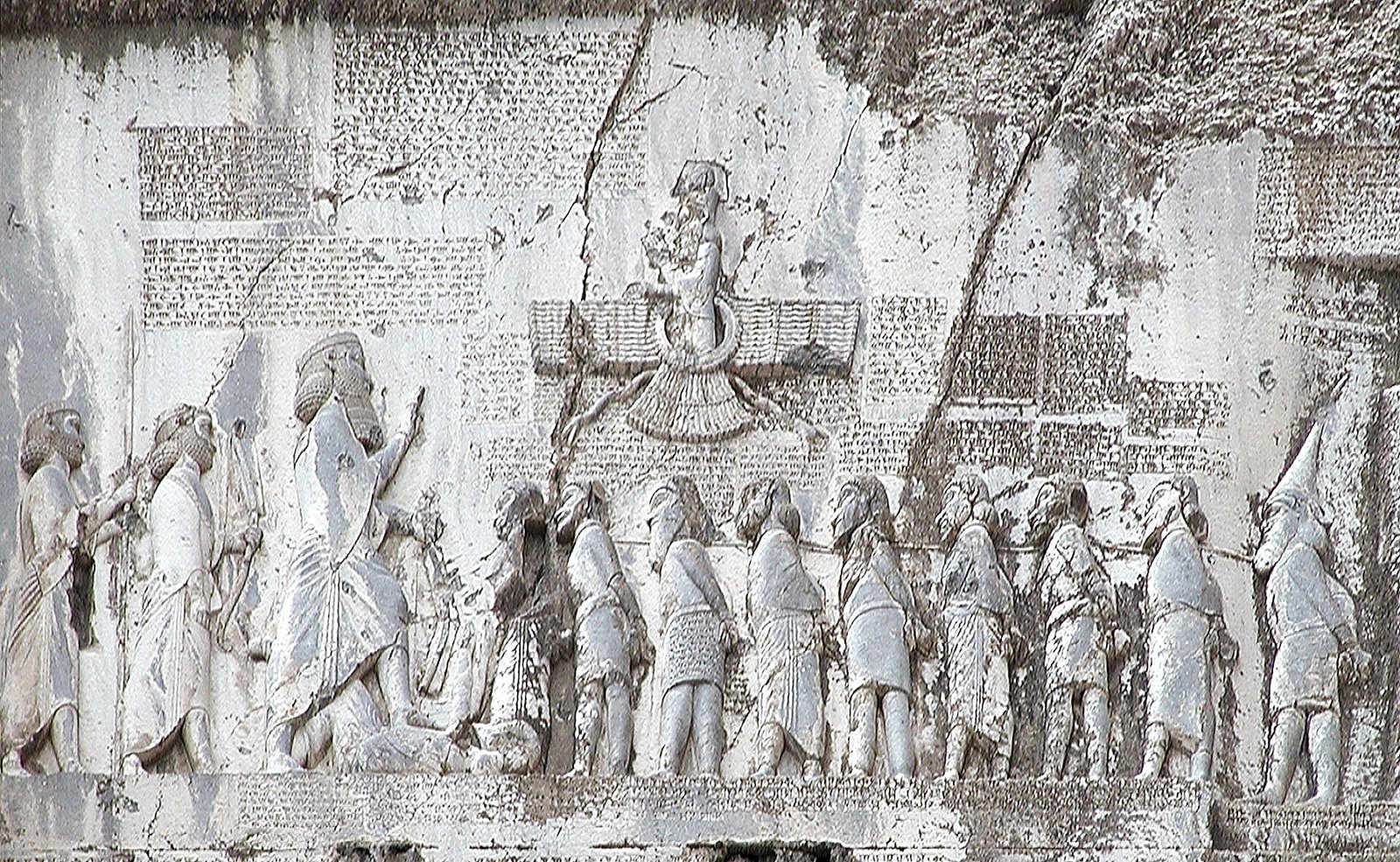
The relief gives this argument a visible form. Darius holds a bow, a symbol of sovereignty, and places his foot on the chest of a fallen figure identified as Gaumata. Two attendants stand behind him. Nine prisoners with bound hands face him, while the fallen figure forms a tenth defeated person.
What are the Behistun Inscription languages?
The three historical languages are Old Persian, Elamite, and the Babylonian dialect of Akkadian. In CDLI’s inventory, the Old Persian text has 414 lines. The second Elamite version has 260 lines, while the Babylonian text has 112. Their different lengths are an immediate warning against imagining identical layouts.
The monument also developed over time. Rüdiger Schmitt dates its formation to stages around 520–518 BCE and explains that it was not trilingual from the beginning. Its final arrangement records a process of additions and changes, rather than a single act of carving.
Even the content does not match throughout. An addition in the fifth Old Persian column describes campaigns in Elam and against the Saka. That passage does not occur in the main texts of the other two languages. When you compare translations, the language version therefore matters.
Is the Behistun Inscription propaganda?
Darius’s account makes a case for his legitimacy. It associates him with a royal dynasty and Ahuramazda, while presenting defeated rivals as false claimants. Short inscriptions attached to opponents such as Aššina, Nidintu-Bel, and Arakha accuse them of lying about their claims to kingship.
The Gaumata story is especially disputed. An alternative historical hypothesis holds that Darius killed the real Bardiya and created the impersonation story to justify taking power. Pierre Briant discusses this possibility as a hypothesis, rather than an established fact. The distinction matters because the inscription’s confidence does not settle the question.
Babylonian tablets confirm that a king called Barziya or Bardiya received official recognition for several months. They do not, by themselves, establish whether that ruler was the real Bardiya or Gaumata. The evidence supports the existence of the reign while leaving the ruler’s identity disputed.
Copies of the Behistun text have been found in Babylon and on Elephantine Island in Egypt. Darius’s account therefore existed beyond its cliff setting. Those copies also show why the monument should be read as a royal message whose circulation extended beyond the carved surface.
How did the trilingual text help unlock cuneiform?
One important route into Old Persian involved matching personal and place names with forms already known from Greek sources. A familiar name could help scholars investigate unfamiliar signs. Think of spotting a name you recognize on an otherwise unreadable label: recognition gives you a starting point for comparison.
Progress began before Rawlinson copied Behistun. Grotefend made an important advance in Old Persian decipherment in 1802. Rawlinson’s own initial work concerned the Elvend inscriptions near Hamadan. Behistun joined an investigation that already had earlier results and other texts to draw upon.
Rawlinson began copying Behistun’s Old Persian text in May 1836. He completed the remaining portion in the first week of September 1837. In January 1838, he sent translations of its first two paragraphs to the Royal Asiatic Society. The first part of his extensive study appeared in 1846.
The other language versions broadened opportunities for comparison. However, Westergaard and Hincks based their first Elamite decipherments in the 1840s on texts from Persepolis and Naqsh-e Rustam. That work preceded their access to Behistun impressions. The route to reading these languages crossed several sites.
Kenneth Cathcart also challenges the idea that Behistun alone solved cuneiform. The main Babylonian text was published only at the end of 1851. In his assessment, it was not decisive during the initial decipherment of Akkadian. Behistun’s contribution belongs within a wider scholarly effort.
A separate test followed in 1857. The Royal Asiatic Society compared independent translations by Rawlinson, Hincks, Talbot, and Oppert of an inscription of Tiglath-Pileser I. Their agreement confirmed the success of the decipherment method. The test concerned another inscription, extending the evidence beyond Behistun.
Behistun Inscription full text, translation, and PDF
You can read an English translation through the University of Richmond’s 13-page Behistun PDF. It is based on King and Thompson’s 1907 work and includes minor changes. Its numbered sections make passages such as the royal claim in I.4–5 and the country list in I.6 easier to locate.
When reading the text, keep the monument’s development in mind. The Old Persian fifth-column addition is absent from the other two main language versions. A translation is therefore best approached with attention to which version and section you are reading, especially when comparing passages across languages.
Timeline
- About 520–518 BCE: The relief and language versions developed in stages, according to Schmitt’s dating.
- 1802: Grotefend made an important early advance in Old Persian decipherment.
- 1836–1837: Rawlinson copied Behistun’s Old Persian text.
- January 1838: Translations of the first two paragraphs were sent to the Royal Asiatic Society.
- 4–10 September 1844: Rawlinson recopied the texts.
- 1846: The first part of his Old Persian Behistun study appeared.
- September 1847: The main Babylonian text was copied using a telescope and climbing assistance.
- 1851: Work on the main Babylonian text was published.
- 1857: Four independent translations of another inscription confirmed the decipherment method.
- 2006: Bisotun entered the UNESCO World Heritage List.
Details you won’t find in guidebooks
The Elamite text survives in two arrangements on separate surfaces. The first has 323 lines; the second has 260. When the pointed-cap figure of the Saka leader Skunkha was added, part of the first arrangement was removed. The text was then carved again elsewhere.
Space also affected individual labels. The Old Persian identification inscription coded DBe was carved onto the clothing of the prisoner it identified. Elsewhere, lime deposits covered some signs while also slowing their erosion. Both crowding and surface deposits influenced what later readers encountered.
Rawlinson left a personal mark during his work of 4–10 September 1844: he carved his own name beneath the monument. In September 1847, he copied the main Babylonian text through a telescope. A Kurdish boy climbed the rock to help obtain paper impressions.
FAQ
Where is the Behistun Inscription?
It is on Mount Behistun in Iran, about 30 kilometres east of Kermanshah, on the historical route connecting Babylon with India.
What languages appear in the Behistun Inscription?
The inscription uses Old Persian, Elamite, and the Babylonian dialect of Akkadian. Its language versions developed in stages and do not contain exactly the same material.
What does the Behistun Inscription say?
It presents Darius I’s account of his royal ancestry, accession, and victories over rivals. Darius claims that Ahuramazda granted him kingship and that Gaumata seized the throne by impersonating Bardiya.
Where can I read an English translation PDF?
The University of Richmond hosts a 13-page English translation based on King and Thompson’s 1907 publication, presented with minor changes.
Sources
- UNESCO — Bisotun whc.unesco.org
- CDLI — Bīsitūn Inscription cdli.earth
- Encyclopaedia Iranica — Bisotun iii iranicaonline.org
- Encyclopaedia Iranica — Gaumāta iranicaonline.org
- Encyclopaedia Iranica — Rawlinson ii iranicaonline.org
- CDLJ — The Earliest Contributions to the Decipherment of Sumerian and Akkadian cdli.earth
- University of Richmond — Behistun English Translation facultystaff.richmond.edu
Image: Behistun inscription reliefs.jpg — Unknown artistUnknown artist, Public domain