Canaanite religion is a scholarly term for the mostly polytheistic beliefs of southern Levantine communities during approximately the third through first millennia BCE. It had no single founder or sacred book. The Ugaritic tablets describe El as a wise creator and father, Baal as a storm god pursuing divine kingship, and Asherah, called Athirat, as El’s wife.
Yet a god’s prominence in a story did not necessarily match the offerings received in worship. If you follow the evidence from tablets to temples and bronze figures, you encounter different views of religious life. Those differences help explain both what Ugarit reveals and where comparisons with other Canaanite communities need care.
Which periods and communities does the scholarly term Canaanite religion cover?
The term covers a long span of changing regional traditions. It does not describe one institution that remained constant across the third, second, and first millennia BCE. Communities could share deities while assigning them different levels of importance. There was no single state theology binding all Canaanite cities together.
The category’s boundaries are also debated. K. L. Noll treats ancient Israelite religion as a local form of regional Canaanite religion. Some scholars of religion place Israelite and Canaanite traditions in separate categories. This disagreement concerns how related religious traditions should be grouped.
Ugarit contributes detailed evidence within this broader discussion. Yale’s course material dates the Ras Shamra religious texts to 1500–1200 BCE. It places Ugarit within the cultural continuity of Syria-Palestine during the second and first millennia BCE. That framework supports comparison without making every community identical.
What were the roles of El, Baal, Asherah, and Anat?
El appears as an elderly, wise creator and the father of gods and humans. These descriptions establish his ancestral authority. Yet the surviving Ugaritic literature contains no creation narrative comparable to the biblical account. Calling El a creator therefore does not supply a complete surviving story of creation.
Baal is a warrior storm god associated with the fertility of agriculture dependent on rain. Yale’s course material identifies him as Dagan’s son and explains his name as meaning lord or husband. His sacred mountain, Saphon, is identified with present-day Jebel Aqra.
You can connect Baal’s agricultural role with an everyday concern: food on your table. His association with rain concerns the fertility of rain-dependent crops. That connection gives his storm power a practical dimension alongside the struggles for kingship described in myth.
Asherah is called Athirat at Ugarit and appears as El’s wife. The passage designated KTU 1.4.VI.46 associates her with seventy divine sons. This places her within the divine family. In the Hebrew Bible, however, the word asherah can also mean a sacred tree or pole connected with the goddess’s cult.
Anat appears as El’s daughter, Baal’s sister, and a goddess of hunting and warfare. Her role becomes decisive after Baal descends into the realm of death. She attacks Mot and dismembers his body, helping bring about Baal’s return. Her actions make her central to the narrative’s conflict.
When were the Ugaritic tablets discovered, and what do they reveal?
The discoveries began with a tomb. In 1928, a farmer accidentally found one in northwestern Syria, leading to the identification of the cemetery near ancient Ugarit. Excavations directed by Claude Schaeffer began at Minet el-Beida in April 1929 and at the Ras Shamra mound on 9 May 1929.
The first alphabetic cuneiform tablets emerged that same year. Ugarit’s archives contain divine lists, poetic mythological narratives, and ritual instructions. Alongside texts in the local language, excavators found Sumerian, Akkadian, and Hurrian texts. The archives thus came from a multilingual setting.
The Baal Cycle survives on six clay tablets dated to the thirteenth century BCE. It follows Baal’s rise to divine kingship. Its principal episodes include conflict with the sea god Yamm, the building of Baal’s palace, and an invitation from Mot, the god of death, to descend below.
These narratives reveal relationships as well as divine powers. El’s paternal position, Athirat’s family role, and Baal’s pursuit of kingship belong to a world structured through divine households and authority. In 2005, Wayne Pitard and Mark S. Smith argued that family politics and patriarchal hierarchy were more prominent than earlier sexual interpretations allowed.
Timeline
- Approximately the third through first millennia BCE: The broad chronological scope of Canaanite religion; regional beliefs changed throughout this period.
- 2000–1600 BCE: The period assigned to the Carlos Museum’s bronze Smiting God figure.
- 1500–1200 BCE: Yale’s date range for the Ras Shamra religious texts.
- Thirteenth century BCE: The six clay tablets of the Baal Cycle were written.
- 1928: A farmer accidentally discovered an ancient tomb near Ugarit.
- 1929: Excavations began at Minet el-Beida and Ras Shamra; the first alphabetic cuneiform tablets were found.
- 1930: Bronze tools bearing dedicatory inscriptions contributed to deciphering Ugaritic writing.
- 2005: Pitard and Smith argued that family politics and patriarchal hierarchy were more prominent in the Baal Cycle than earlier sexually focused readings suggested.
How far can Ugarit’s religion represent other Canaanite cities?
Ugarit offers substantial evidence, but its gods cannot automatically stand for every city’s religious priorities. The importance of individual deities varied with local conditions. Without a single state theology across Canaanite cities, shared names do not establish identical systems of worship.
Social representation poses another limit. Ugarit’s texts were produced for wealthy groups. It is difficult to establish how fully the beliefs and ceremonies they describe were shared by peasants. You should therefore distinguish the religious world preserved in elite texts from claims about everyone in the surrounding countryside.
Even within Ugarit, divine lists and offering lists do not fully match. A deity’s visibility in mythology cannot be equated directly with importance in worship. A long narrative and an offering record answer different questions: one presents divine actions, while the other records ritual attention.
What do temples and votive objects reveal about worship?
Two temples on Ugarit’s acropolis, traditionally named for Baal and Dagan, were uncovered in the excavations of 1929 and 1934. These buildings provide architectural evidence to compare with the tablets. Palace spaces, archival documents, and burial chambers also indicate a royal cult of the dead.
Objects can suggest divine identities without settling them. The Metropolitan Museum’s seated deity, numbered 32.161.45, is interpreted as probably El. Made of bronze with gold leaf, it measures 13.7 centimetres and dates to the fourteenth–thirteenth centuries BCE. The museum’s cautious identification matters when relating an image to a named god.
Evidence from Lachish adds another local setting. The preliminary report on the 2013–2017 excavations records two bronze figures of attacking gods in a Canaanite temple. It also records three bronze cauldrons buried beneath the floor, probably as foundation offerings. Their placement provides evidence for ritual activity beyond mythological storytelling.
Details you won’t find in guidebooks
In KTU 1.2.IV, the craftsman god Kothar-wa-Hasis makes two clubs for use against Yamm. Their names are Yagrush and Ayamur. Some Baal Cycle tablets also preserve ancient scribal margin notes identifying the text as belonging to Baal. The tablets contain traces of copying practice alongside the narrative itself.
Bronze tools from the building called the high priest’s house bear Ugaritic dedicatory inscriptions. These inscriptions helped decipher the script in 1930. Objects associated with dedication thus contributed to reading the written evidence for Ugarit’s religion.
The Carlos Museum’s Smiting God offers another small but revealing detail. The bronze figure stands 19 centimetres high and dates to 2000–1600 BCE. Two projections beneath each foot show that it was fastened to a base. It may represent Baal, but other Canaanite gods shared the attacking pose. Its possible use as a temple offering also remains an interpretation.
How can archaeological evidence be distinguished from biblical polemic?
Begin by separating the kinds of evidence. A temple floor, a bronze figure, a ritual list, and a polemical passage preserve different information. The uncertain identification of the Carlos Museum figure demonstrates why an archaeological object should not automatically receive the name of a familiar textual deity.
Biblical polemic also has a history of influencing interpretation. According to Pitard, sexually focused biblical attacks on Canaanite religion affected earlier readings of the Ugaritic tablets. His team used computer imaging and macro photography to reassess those readings. Pitard and Smith emphasized family politics and patriarchal hierarchy in their 2005 discussion.
Aicha Rahmouni’s 2007 study, Religion at Ugarit, examines the official pantheon and everyday religion through epic texts, ritual texts, and archaeology together. This combined approach keeps the divine stories in view while also considering evidence for religious practice.
FAQ
What was Canaanite religion?
Canaanite religion is a scholarly term for the mostly polytheistic traditions of southern Levantine communities during approximately the third through first millennia BCE. It had no single founder or sacred book.
What do the Ugaritic tablets reveal about El, Baal, and Asherah?
They describe El as a wise creator and divine father, Baal as a storm god seeking divine kingship, and Asherah, called Athirat at Ugarit, as El’s wife within the divine family.
When were the Ugaritic tablets discovered?
The first alphabetic cuneiform tablets were found in 1929. Excavations followed a farmer’s accidental discovery of a tomb near Ugarit in 1928.
Can Ugarit’s religion represent every Canaanite city?
Ugarit provides detailed evidence, but divine importance varied between communities. Its texts were also produced for wealthy groups, which limits how confidently they can represent rural beliefs.
Sources
- Wikipedia — Canaanite religion en.wikipedia.org
- K. L. Noll, Brandon University — Canaanite Religion people.brandonu.ca
- Open Yale Courses — Canaanite Religion oyc.yale.edu
- Aicha Rahmouni, Religion Compass — Religion at Ugarit compass.onlinelibrary.wiley.com
- The Metropolitan Museum of Art — The Gods and Goddesses of Canaan metmuseum.org
- Ras Shamra-Ougarit Archaeological Mission — Mission website mission-ougarit.fr
- University of Illinois — Taming the Fertility God, Baal las.illinois.edu
- French Ministry of Culture — Le cycle de Baal archeologie.culture.gouv.fr
- HISOMA — Les sanctuaires de l’acropole d’Ougarit hisoma.mom.fr
- UNESCO World Heritage Centre — Ugarit tentative listing whc.unesco.org
- Michael C. Carlos Museum, Google Arts & Culture — Smiting God artsandculture.google.com
- The Metropolitan Museum of Art — Enthroned deity metmuseum.org
- American Journal of Archaeology — The Canaanite and Judean Cities of Lachish ajaonline.org
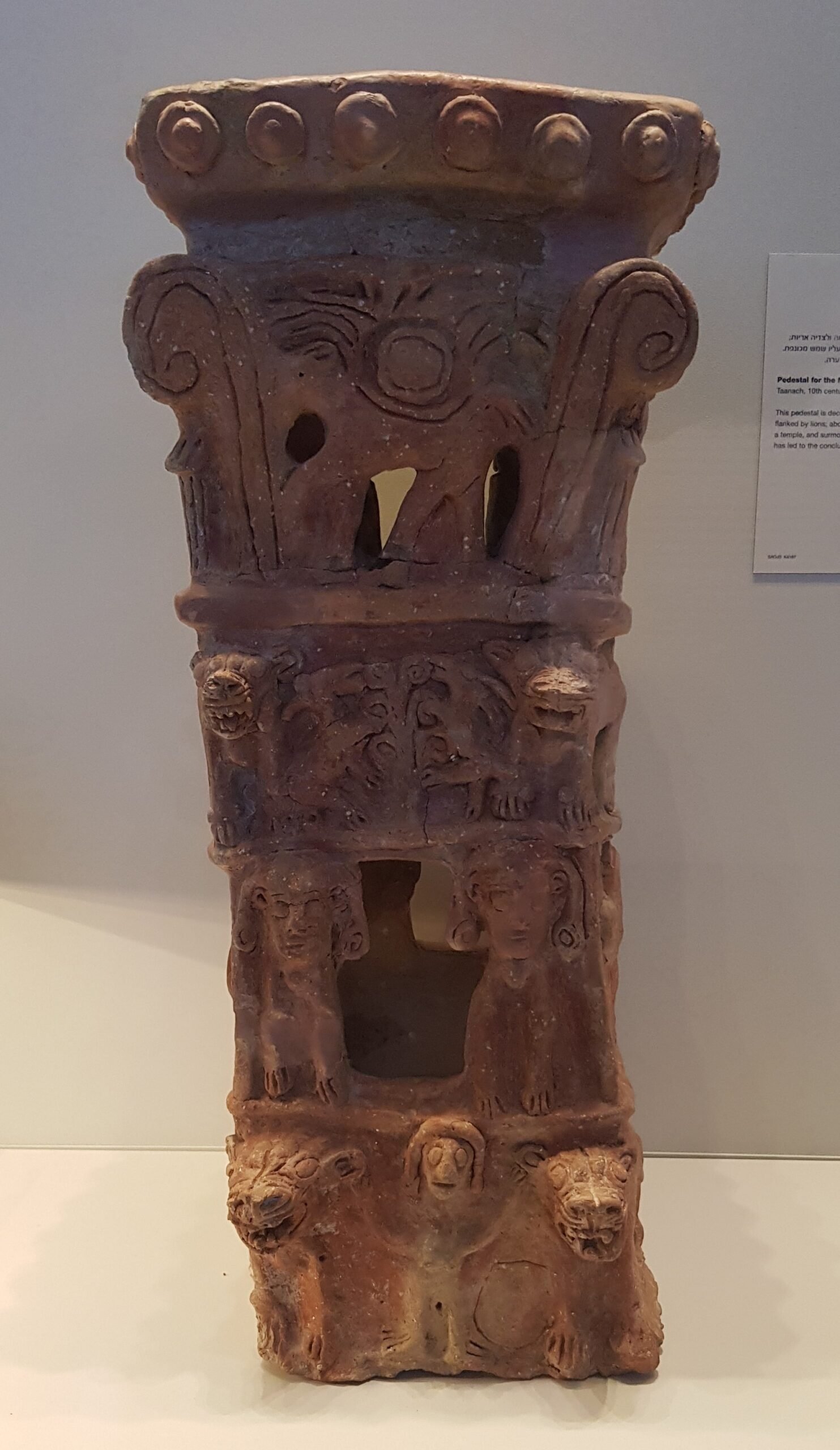
Image: Cultic incense stand from Ta'anach.jpg — פעמי-עליון, CC BY-SA 4.0