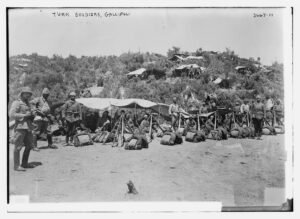
The Sarikamish Campaign is one of the most quoted battles of World War I in Turkey. It is also one of the most misquoted. The usual story says 90,000 soldiers froze to death in the snow. The record is more complicated than that.
When Was the Battle of Sarikamish, and Where Did It Fit in WWI?
The campaign was fought on the Caucasus Front of World War I. The two sides were the Ottoman and Russian empires. The Ottoman attack began on 22 December 1914 and ended in defeat in January 1915.
The end date depends on the source. Turkish Wikipedia gives 22 December 1914 to 6 January 1915. English Wikipedia also counts the Russian counterattack, so it runs to 17 January 1915.
Battle of Sarikamish Location and Map
You can picture the map in words. Sarikamish sits in today’s Kars province. In 1914 the town belonged to the Russian Empire, inside the Kars Oblast.
The fighting did not stay in one place. It spread around Sarikamish and along the Erzurum side of the front. That area includes Oltu, Narman, Bardiz and Horasan.
If you travel in this region today, remember that these are the same mountain roads and high valleys where the armies moved in winter.
Why Did the Ottomans Attack?
The first strategic aim on the Caucasus Front was to win back Kars, Ardahan and Batum. The Ottoman Empire had lost all three at the end of the 1877–1878 Ottoman-Russian War.
The plan around Sarikamish was bold. Taking the town would cut the Russian army’s railway link toward Kars. It would also leave the main Russian force surrounded.
The Plan and the Men Behind It
Enver Pasha was Deputy Commander-in-Chief and Minister of War. On 19 December 1914 he took command of the Third Army himself.
Three corps carried out the plan:
- The 9th Corps was under Ali Ihsan Pasha.
- The 10th Corps was under Hafiz Hakki Bey.
- The 11th Corps was under Galip Pasha.
The 11th Corps had the job of holding the Russians in front. The 9th and 10th corps would march in from the north and swing behind them.
On the Russian side the command group included Nikolay Yudenich, Georgi Bergmann and Aleksandr Myshlaevsky.
Warnings Before the Attack
Not everyone believed in the plan. On 18 December 1914 Hasan Izzet Pasha sent a telegram. He wrote that preparations were not enough. He also warned that the 11th Corps, left alone in front, could be crushed. He said the outcome of the attack was doubtful.
He was right to worry about supply. Troops and materiel reached Ulukisla by train. From there they still had to cover about 1,000 kilometres by road to the front. That journey could take two months.
Think of waiting two months for a parcel that must cross mountains on foot and by cart. That was how an army’s food, clothing and ammunition travelled.
What Happened in the Mountains
Hafiz Hakki’s advance toward Oltu and Ardahan made the encirclement route longer. It also forced the 10th Corps to cross the Allahuekber Mountains in the middle of winter.
Then came the weather. A snowstorm hit on 25–26 December 1914. Together with the mountain marches, it badly reduced the fighting strength of the 9th and 10th corps. These were the very units meant to close the trap.
On the night of 29 December, about 600 men of the 93rd Regiment entered Sarikamish. A Russian counterattack followed, and the Ottomans could not hold the town.
Who Won the Battle of Sarikamish?
The Russian Empire won. The Ottoman offensive ended in defeat in January 1915.
Mustafa Kemal was not there. During the campaign he was military attaché in Sofia. On 20 January 1915 he was appointed commander of the 19th Division.
Timeline
- 18 December 1914: Hasan Izzet Pasha reports his doubts about the attack.
- 19 December 1914: Enver Pasha takes command of the Third Army.
- 22 December 1914: The Ottoman encirclement offensive begins.
- 23 December 1914: Friendly fire breaks out near Oltu between the Ottoman 31st and 32nd divisions.
- 25–26 December 1914: A snowstorm and mountain crossings cause heavy losses in the encircling units.
- 29 December 1914: Ottoman troops enter Sarikamish but cannot keep the town.
- January 1915: The offensive ends in defeat. English Wikipedia dates the Russian counterattack to 17 January.
- April 1915: According to SERKA, the bodies of soldiers come to light and villagers are organised to collect them.
Battle of Sarikamish Casualties: Did 90,000 Really Freeze?
This is the question most readers come for. The short answer is that the 90,000 figure is not supported by the accounts reviewed here.
The number comes from Larcher’s work of 1926. Other counts are much lower. They also measure different things, which is why the figures are so hard to compare.
- Felix Guze’s collected reports: 30,000 dead and 7,000 prisoners.
- The official breakdown Hummet Kanal cites from Erickson: 23,000 dead, 10,000 who died in hospital, 7,000 prisoners and 10,000 wounded. That adds up to 50,000 casualties.
- Fevzi Cakmak, in 1935: 60,000 lost.
- Researcher Ramazan Balci: a total loss of under 50,000.
- The Harp Encumeni account, quoted by SERKA: 33,000 dead and prisoners, and 57,000 total casualties.
Look closely at that last figure. The 57,000 total includes 7,000 prisoners and 17,000 sick or wounded men. You cannot read it as a death toll.
Russian losses were also heavy. SERKA, citing General Maslovsky, gives about 32,000 casualties including prisoners. That number does not count only the dead either.
So what do we know? Many men did die, and the cold was part of it. But the exact number of dead is still disputed. A casualty total and a count of men who froze are two different things.
Details You Won’t Find in Guidebooks
- Ships lost at sea. In November 1914 the ships Mithat Pasha, Bezm-i Alem and Bahr-i Ahmer were carrying aid to the front. The Russians sank all three in the Black Sea.
- A two-hour mistake. On 23 December near Oltu, the Ottoman 32nd Division fired for about two hours on the 31st Division. It believed it was facing a Russian unit.
- Disputed friendly-fire losses. Serif Ilden reports about 2,000 casualties from that incident. Fahri Belen says the highest estimate among the officers he spoke to was 250.
- Burial parties of one hundred. When the bodies came to light in April 1915, villagers from the surrounding area formed groups of a hundred people. Each group had an imam assigned to lead it, SERKA says.
Battle of Sarikamish 1920, Vermati and Other Searches
People often search for “Battle of Sarikamish 1920” or “Battle of Vermati”. The Sarikamish campaign described here ran from December 1914 into January 1915, and it is the one most readers mean.
FAQ
Who won the Battle of Sarikamish?
The Russian Empire won. The Ottoman offensive that began on 22 December 1914 ended in defeat in January 1915.
When was the Battle of Sarikamish?
The Ottoman attack began on 22 December 1914. Turkish Wikipedia gives the end as 6 January 1915. English Wikipedia includes the Russian counterattack and extends it to 17 January 1915.
Did 90,000 Ottoman soldiers freeze to death at Sarikamish?
The sources reviewed do not confirm it. The 90,000 dead figure appears in Larcher’s 1926 work. Other accounts give totals between under 50,000 and 60,000 casualties, and those totals include prisoners, the sick and the wounded.
Where is Sarikamish?
Sarikamish is in today’s Kars province. In 1914 it lay inside the Russian Empire’s Kars Oblast.
Sources
- Wikipedia — Battle of Sarikamish en.wikipedia.org
- Vikipedi — Sarikamis Harekati tr.wikipedia.org
- Turk Tarih Kurumu — Enver Ziya Karal, I. Dunya Savasi’nda Kafkas Cephesinde: Sarikamis Savasi ttk.gov.tr
- Hummet Kanal — Sarikamis Harekati Esnasinda Cephede Yasananlar ve Anadolu’ya Etkileri dergipark.org.tr
- SERKA — Turk Halkinin Sarikamis Algisi serka.gov.tr
- Milli Savunma Bakanligi — Ataturk’un Askeri Gorevleri ata.msb.gov.tr
Image: Sarikam.jpg — Wikimedia Commons, Public domain