You have probably seen a mummy in a museum and wondered how a body could last for thousands of years. The answer is a mix of chemistry, patience and belief. Here is how it worked, step by step.
What Is a Mummy?
A mummy is a human or animal body whose soft tissues have been preserved. Chemical treatment, dryness, extreme cold or a lack of air can all do this. Some mummies form by accident. Egyptian mummies were made on purpose.
Why Did Ancient Egyptians Preserve the Body?
The reason was belief. Egyptians thought the ba (the soul) and the ka (the life force) still needed a physical anchor after death. If the body decayed, that anchor was gone. So they worked to keep it intact.
Where Did Mummification Begin?
An older theory said mummification began around 2600 BCE among royalty. Newer finds challenge that. Graves at Hierakonpolis, dated to about 3500 BCE, belonged to people who were not elites. They show organs being removed and parts of the body being wrapped. The practice is older than the theory said, and it was not only for kings.
A mummy in the Egyptian Museum of Turin adds to this. It dates to about 3700–3500 BCE. Analyses published in 2018 showed that desert sand alone did not dry it out. Someone treated it with preservatives. The wrappings held a mix of plant oil, heated conifer resin, an aromatic plant extract and a plant gum or sugar.
How Did Ancient Egyptians Mummify the Dead, Step by Step?
The Australian Museum calls the method used from about 1550 to 664 BCE for royals and high officials one of the most advanced and complex mummification techniques. Preparing and wrapping the body took about 70 days. The steps below follow the New Kingdom version.
1. The embalming house
The first treatments took place in a mummification workshop called the Per-Nefer.
2. Removing the brain and organs
The embalmers pushed a long bronze tool up through the nose to pull out the brain. They reached the other internal organs through cuts in the abdomen and diaphragm.
The heart was handled differently. Egyptians regarded it as the center of knowledge and emotion, so it was usually left inside the body. The brain was often discarded.
3. Treating the organs separately
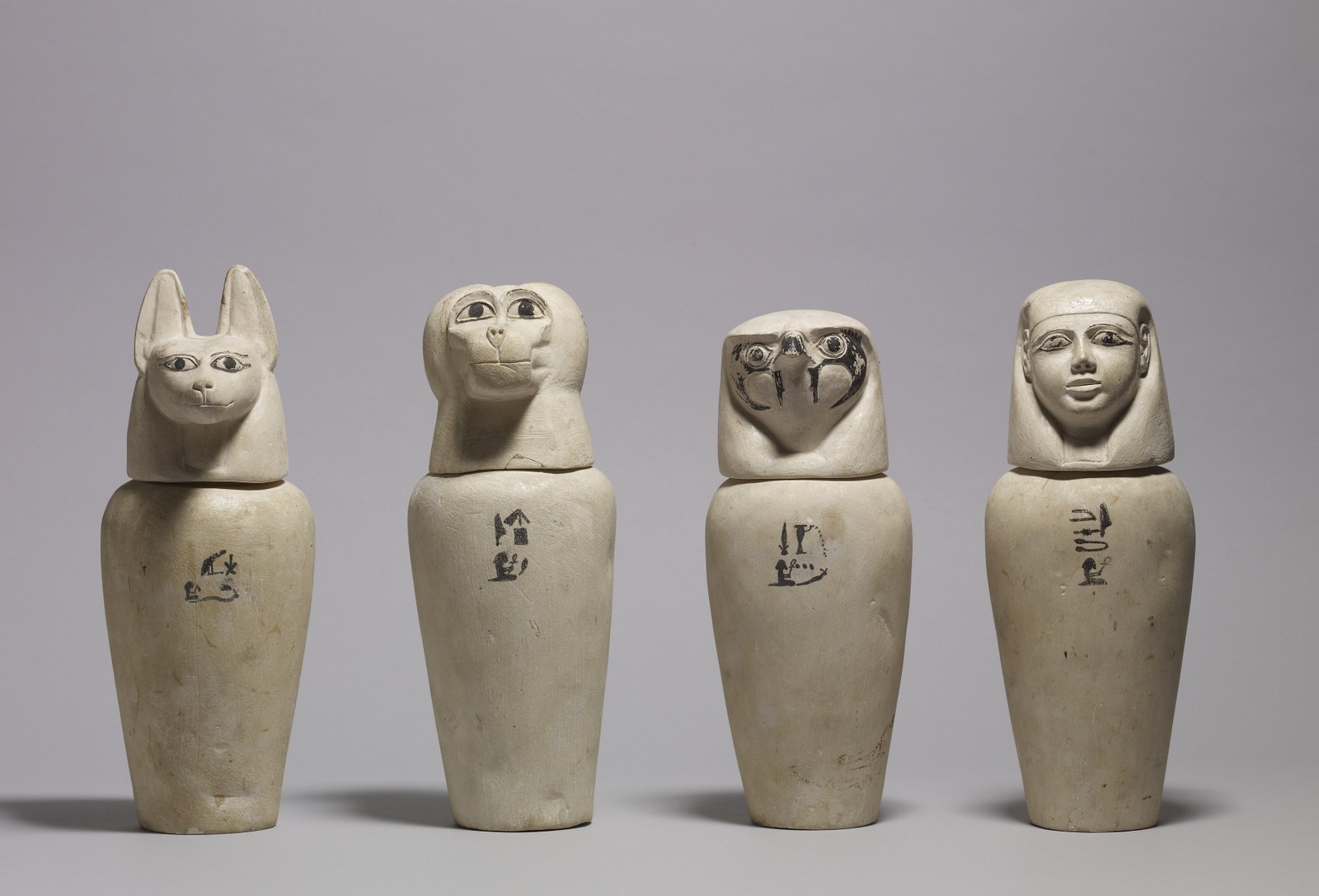
The lungs, stomach, liver and intestines were each mummified on their own. Each set was then placed in a canopic jar. The lids of these jars represent the four sons of Horus. The jackal-headed jar protected the stomach, which had been dried and wrapped in linen.
4. Drying with natron
Now came the key step. Natron is a carbonate salt collected from the edges of desert lakes. It draws water out of the body and helps stop rot. After about 40 days of drying, it was removed.
Think of the salt you sprinkle on sliced vegetables in your kitchen. It pulls the water out. Natron did the same job on a much larger scale.
5. Filling the body
Once the body was dry, the cavities could be packed with linen, bags of natron, herbs, sawdust, sand or chopped straw. This helped the body keep its shape.
6. Wrapping in linen
Embalmers wrapped fingers and limbs one by one in linen. Between the layers they placed amulets and jewelry.
Timeline
- 3700–3500 BCE: The Turin mummy dates from this period. Its wrappings contained a preservative mix.
- About 3500 BCE: Graves at Hierakonpolis show organ removal and the wrapping of body parts.
- About 1550–664 BCE: Advanced mummification was used for royals and high officials.
- After about 1000 BCE: Removed organs could be returned to the body or placed beside it.
- 26th Dynasty: The Saqqara embalming workshop studied in 2023 was in use.
- 1898: Victor Loret found hidden royal mummies in the tomb of Amenhotep II, KV35.
- 2018: Analyses of the Turin mummy’s preservative mix were published.
- 2023: Chemical analyses of labeled vessels from the Saqqara workshop were published in Nature.
What If You Could Not Afford All This?
Full mummification cost money. People who could not pay for detailed treatment still had options. Their bodies could be dried in hot desert sand or coated in resin. These methods were cheaper, and they still preserved the body.
What Happened at the Funeral?
Once the body was ready, the funeral could begin. Here is the order of events:
- In wealthy families’ processions, two women, relatives or priestesses, could play the roles of Isis and Nephthys, the main mourning goddesses.
- The procession carried the canopic jars and the grave goods.
- The mourners crossed to the west bank of the Nile in boats. The west bank was the preferred side for burials.
- At the tomb entrance, priests performed the Opening of the Mouth. They held the mummy upright. Prayers, purification and ritual objects were used to touch it, so the dead person could use their senses in the next world.
- Food and clothing were offered to the dead.
- After a funeral meal, the mummy was placed in the burial chamber.
Were Animals Mummified Too?
Yes, and in huge numbers. Some animal cemeteries in Egypt hold millions of mummies. Many of those animals were not pets. They were raised to be offered to the gods.
Where Can You See Royal Mummies?
If you visit Cairo, the Royal Mummies Hall of the National Museum of Egyptian Civilization is the place to go. The museum says it holds 20 mummies: 18 kings and 2 queens from the 17th to 20th Dynasties.
Royal mummies were also found in 1898. The French Egyptologist Victor Loret discovered the tomb of Amenhotep II (KV35) in the Valley of the Kings. In another chamber he found 13 hidden mummies, nine of them kings.
Details You Won’t Find in Guidebooks
- The word “mummy” may come from tar. It is linked to mummiya, a Persian and Arabic word for tar or bitumen. Yet the dark look of Egyptian mummies mostly comes from resins.
- Fingernails could be tied on. In the New Kingdom, embalmers could tie nails to fingers and toes so they would not fall off while the body dried.
- Eyes got padding. Some New Kingdom embalmers placed pads or onions under the eyelids.
- Organs came back. After about 1000 BCE, organs could be returned to the body or placed beside it. Even so, tombs could still contain symbolic canopic jars, empty or filled.
- Labeled pots tell the recipe. The 2023 Nature study analyzed residues from 31 ceramic vessels from a 26th Dynasty embalming workshop at Saqqara. The vessels carried labels for their contents or use. The results identified mixtures used to care for the head and the wrappings.
FAQ
How long did ancient Egyptian mummification take?
In the advanced method, preparing the body and wrapping it in linen took about 70 days. The drying stage with natron lasted about 40 days of that time.
Why did Egyptians remove the organs but leave the heart?
The heart was seen as the center of thought and feeling, so it was usually left inside the body. The brain was often thrown away. The lungs, stomach, liver and intestines were mummified separately and placed in canopic jars.
Could ordinary people be mummified?
Yes, in simpler ways. People who could not afford detailed mummification could be preserved by drying in hot desert sand or by being coated in resin. Finds at Hierakonpolis, dated to about 3500 BCE, show that non-elite people were already being prepared with organ removal and wrapping.
What was the Opening of the Mouth ceremony?
It took place at the tomb entrance. The mummy was held upright, and priests used prayers, purification and ritual objects to touch it. The aim was to let the dead person use their senses in the next world.
Did Egyptians mummify animals too?
Yes. Some animal cemeteries in Egypt hold millions of mummies. A large share of these animals were not pets. They were raised as offerings to the gods.
Sources
- Wikipedia — Mummy en.wikipedia.org
- Australian Museum — Funerals in ancient Egypt australian.museum
- Australian Museum — The origins of mummification in ancient Egypt australian.museum
- Australian Museum — How were ancient Egyptians mummified? australian.museum
- University of York — Prehistoric mummy reveals ancient Egyptian embalming recipe york.ac.uk
- University of Illinois Spurlock Museum — Mummification: The New Kingdom spurlock.illinois.edu
- American Museum of Natural History — Mummies in Egypt amnh.org
- Nature — Biomolecular analyses enable new insights into ancient Egyptian embalming nature.com
- National Museum of Egyptian Civilization — Mummies Hall nmec.gov.eg
Image: Egyptian – A Complete Set of Canopic Jars – Walters 41171, 41172, 41173, 41174 – Group.jpg — Anonymous (Egypt)Unknown author, Public domain